

Key Takeaways
- Vinyl fits the homeowner who wants the least upkeep at the lowest tier. It never needs paint, cleans with a hose, doesn’t rot, and CertainTeed backs it with a lifetime limited warranty.
- Fiber cement fits the homeowner who wants the heaviest, most wood-like look and the longest horizon. It resists impact, moisture, and fire, and James Hardie backs the boards with a 30-year non-prorated substrate warranty.
- Both handle New England when installed to spec. Vinyl’s honest weakness is cold-impact cracking and the room it needs to move; fiber cement’s is weight, dust, and the paint it eventually needs.
- The up-front gap is a tier difference — vinyl sits at “$” and fiber cement at “$$$” — and the install matters more with fiber cement because of how it’s carried and cut.
Vinyl or fiber cement: which one is right for your home?
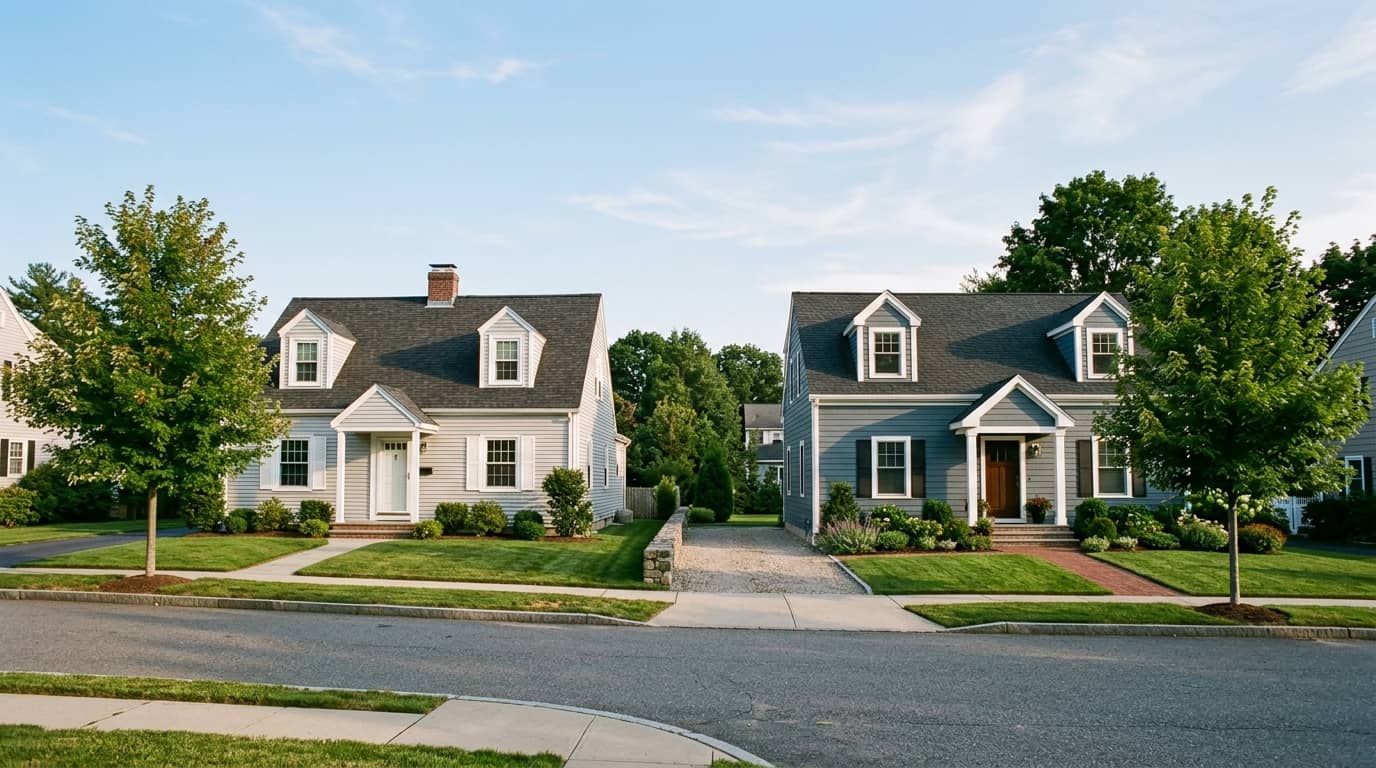
Picture the two houses you’re weighing. One has clean lap siding you never think about: you rinse it in the spring, and it looks the same in year twelve as in year one. The other has deep, wood-grain boards with heavy shadow lines that read like painted cedar from the sidewalk, and every few years someone recoats them. The first is vinyl. The second is fiber cement. Neither is wrong; they answer different questions.
If your question is “how do I get a clean, updated exterior with the least upkeep and the lowest up-front tier?” the answer is usually vinyl. If your question is “how do I get the most substantial, wood-like look and the longest horizon on a house I plan to keep?” the answer is usually fiber cement. Our side-by-side of all three materials we install puts engineered wood between them; this article stays on the two ends.
What is each one actually made of?
Vinyl siding is a PVC plastic panel with the color running through the material. It’s light and hollow, and hung so it can slide a little on its nails. The CertainTeed lines we install — Monogram clapboard and Dutchlap, foam-backed CERTAplank, insulated CedarBoards, and the Cedar Impressions polymer shakes and shingles — all carry CertainTeed’s lifetime limited warranty.
Fiber cement siding is a dense plank of Portland cement, sand, and cellulose fiber pressed with a wood-grain or smooth face. It behaves more like masonry than wood: little expansion, no burning, nothing for insects. We install James Hardie’s HardiePlank, which carries a transferable 30-year non-prorated substrate limited warranty on the board and a separate 15-year finish warranty on its factory ColorPlus color. That substrate warranty covers material, not labor, so the installer matters as much as the brand.
How do vinyl and fiber cement live day to day?
Vinyl asks almost nothing of you. There is no paint to maintain, because there is no paint. A garden hose and a soft brush handle pollen and mildew; a cracked panel is swapped, not patched. What shortens it: a hard impact in the cold, a very dark color on a sun-baked wall, or an install that pinned the panels too tight.
Fiber cement asks for a schedule. The board itself is close to inert, but its finish is paint, factory-applied or field-applied, and paint wears. Caulk at trim and butt joints needs checking, and at some point the house gets recoated. In exchange, the surface holds paint far longer than wood, because the plank isn’t moving with the seasons. If you want the full picture of what each material asks over the years, our article on what siding costs to maintain over its life walks through it material by material.
Find your style, then see it on your own house
TruFit is a two-minute survey that tells you which siding style fits your home and your taste. TruPro then puts it on a 3D model of your actual house — mix and match styles, colors, and trim and watch one total update as you go. Both are part of our free in-person siding assessment.
Schedule a free assessmentHow does each one handle New England cold and wet?
Both get through our winters when they’re installed to the manufacturer’s spec. The differences are in how they cope.
Vinyl moves. It expands in August heat and shrinks in January cold, so the installer leaves gaps at corners and channels and centers each nail in its slot. Get that right and the wall rides out the swings; get it wrong and panels buckle. Vinyl also stiffens in the cold: a stray hockey puck or a ladder foot that would bounce off in summer can crack a panel in winter. That’s a repair, not a material failure, and our material-by-material look at New England winters covers what to expect from each. Water-wise, vinyl doesn’t rot, but it’s a rain screen, not a seal; the house wrap and flashing behind it do the real work.
Fiber cement stays put. It barely moves with temperature, shrugs off impact, and doesn’t absorb water the way wood does, which is why it holds up well on the weather side and on coastal homes. Its vulnerability is the cut edge and the joint: ends need to be sealed and flashed, and the board has to stay clear of soil and snow at the base. It’s also heavy, which is why the install is the whole game with this material.
How do they look up close?
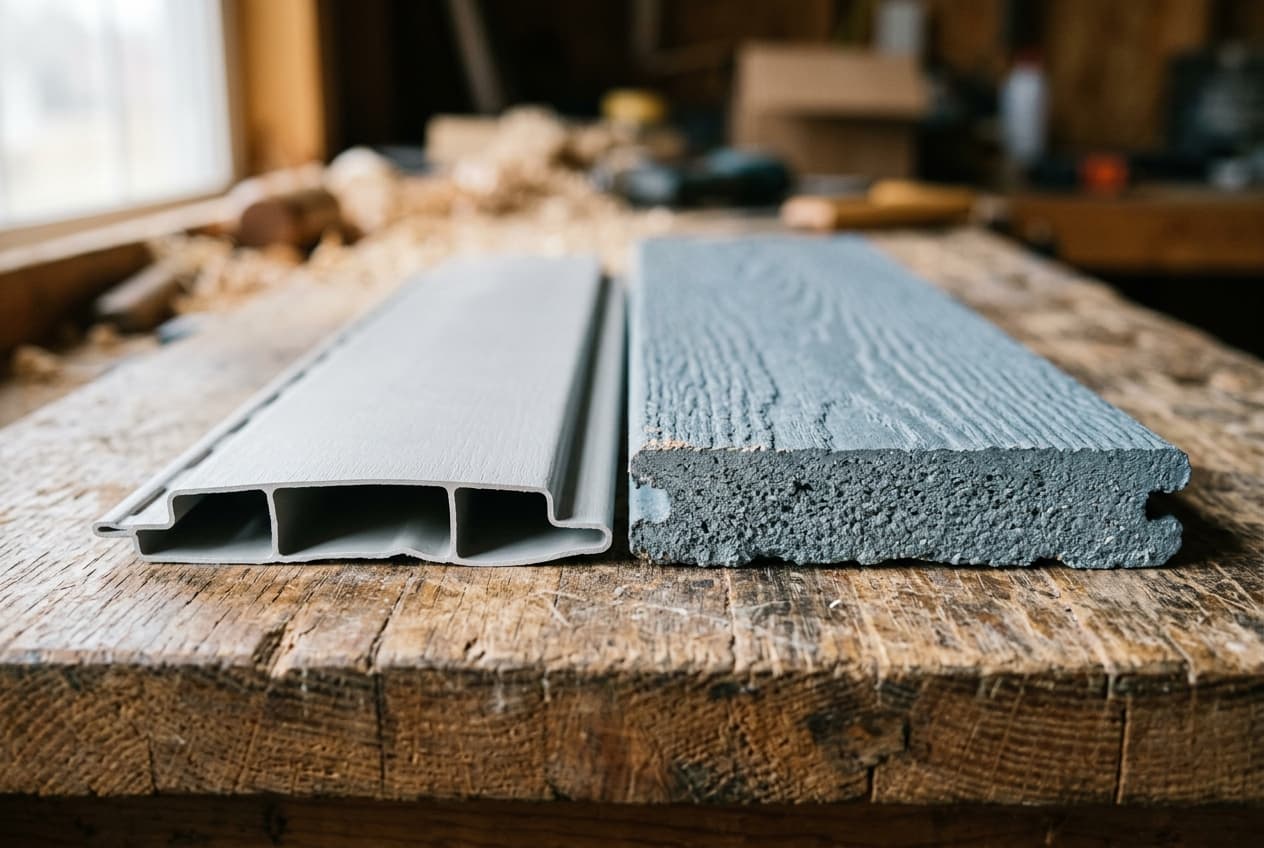
From the curb, a well-chosen vinyl wall and a fiber-cement wall can read alike, especially in a mid-tone with white trim. Up close, the plank tells. Fiber cement is thick, so each course throws a deeper shadow, and its embossed grain looks like milled cedar under a hand. Vinyl is thinner and hollow, so the shadow line is shallower and the grain is a texture on the surface rather than in it. Foam-backed and insulated vinyl lines close some of that gap.
Trim and accents matter as much as the field. Both materials take a shake gable, a contrasting corner, or a board-and-batten front well, and on either one a designed look adds a little to the total, not a lot. We explain why in whether a custom siding design costs more than a plain one. Color holds differently, too: vinyl’s color runs through the panel, while fiber cement’s lives in the finish, a difference we unpack in does vinyl siding fade.
“The homeowners who regret vinyl wanted the fiber-cement look and talked themselves out of it. The homeowners who regret fiber cement wanted to never think about their siding again. Get honest about which one you are before you look at a single sample.”
Global Roofing field team — Massachusetts in-home siding assessments
When is vinyl the smarter call, and when is fiber cement?
On our relative investment scale, vinyl sits at “$” and fiber cement at “$$$.” Part of that gap is the material; part is the labor, because fiber cement takes more hands to carry, special blades and dust control to cut, and more care at every joint. That’s a tier difference that moves with your home’s size and shape, not a fixed number. One more difference: fiber cement is noncombustible, while vinyl, though fire-rated, is a plastic. On a tight lot that can matter.
| Your situation | Usually fits |
|---|---|
| You want the least upkeep and never want to paint | Vinyl |
| You want the heaviest, most wood-like plank and shadow line | Fiber cement |
| You’re updating to sell or plan to move within a few years | Vinyl, or a mid-tier line with more presence |
| You’re staying a long time and want the longest horizon | Fiber cement |
| Exposed weather side, coastal lot, or a lot of hard-impact traffic | Fiber cement, or foam-backed vinyl if upkeep rules |
| Budget is the first filter and the house is simple | Vinyl |
If you land in the middle, that’s the ground engineered wood occupies, and LP SmartSide versus James Hardie is the comparison to read next.
Frequently asked questions
Is fiber cement siding better than vinyl?
Neither is better across the board. Vinyl fits low upkeep and the lowest tier: no paint, a hose to clean, no rot. Fiber cement fits the heaviest wood-like look and the best resistance to impact, moisture, and fire, for a homeowner staying long enough to valueit. Both hold up here when installed to spec.
Does vinyl siding crack in cold weather?
It can. Vinyl stiffens in the cold, so a hard impact in January can crack a panel that would have flexed in July, and it needs room to move as temperatures swing. A cracked panel is a repair, not a re-side. If low maintenance is your priority, vinyl is still the right choice for many New England homes.
Does fiber cement siding need to be painted?
Eventually, yes. It holds paint well because the plank doesn’t move like wood, and factory-finished boards carry a separate 15-year finish warranty, but the finish is still paint and will need recoating. Caulk at joints needs attention on a schedule too. Vinyl is never painted.
Why does fiber cement cost more to install than vinyl?
It’s heavy and dense, so it takes more hands to hang and special blades and dust control to cut, while vinyl is light and fast. The gap is a tier difference that moves with your home’s size and shape, not a fixed number. An in-person assessment gives you one total for each on your own house.
How we wrote this guide
This article reflects what Global Roofing sees installing vinyl and fiber cement on real Massachusetts and New England homes, checked against CertainTeed and James Hardie product and warranty pages, the polymeric exteriors industry installation standards, and Consumer Reports’ siding testing. It was reviewed for accuracy by a licensed Massachusetts contractor on our team. See our full editorial process for how we research and update every article.
Sources
- CertainTeed — Monogram vinyl siding (product details and lifetime limited warranty). certainteed.com
- James Hardie — HardiePlank lap siding and the 30-year substrate and 15-year ColorPlus finish warranties. jameshardie.com
- Polymeric Exteriors Association (formerly the Vinyl Siding Institute) — horizontal siding installation standards, including expansion gaps and fastening. polymericexteriors.org
- Consumer Reports — Siding Buying Guide (material performance and what to know before you buy). consumerreports.org