

Key Takeaways
- All three materials we install are built for cold climates. Each has one winter weak spot: vinyl on hard cold impact, engineered wood at unsealed edges, fiber cement in the demands of the install.
- Freeze-thaw hurts walls through the water that gets in, not the cold itself. Clearance at the base, flashing at every opening, and a sound barrier behind the siding matter on every material.
- Near the coast, salt air and wind-driven rain push the details harder — corrosion-resistant fasteners and outward-shedding flashing — more than they change the material choice.
- Woodpeckers and insects favor wood-based products; treated strands and cement resist them.
- Two identical homes on the same street come through winter differently because of the install, not the brand on the box.
Which siding holds up best to a New England winter?
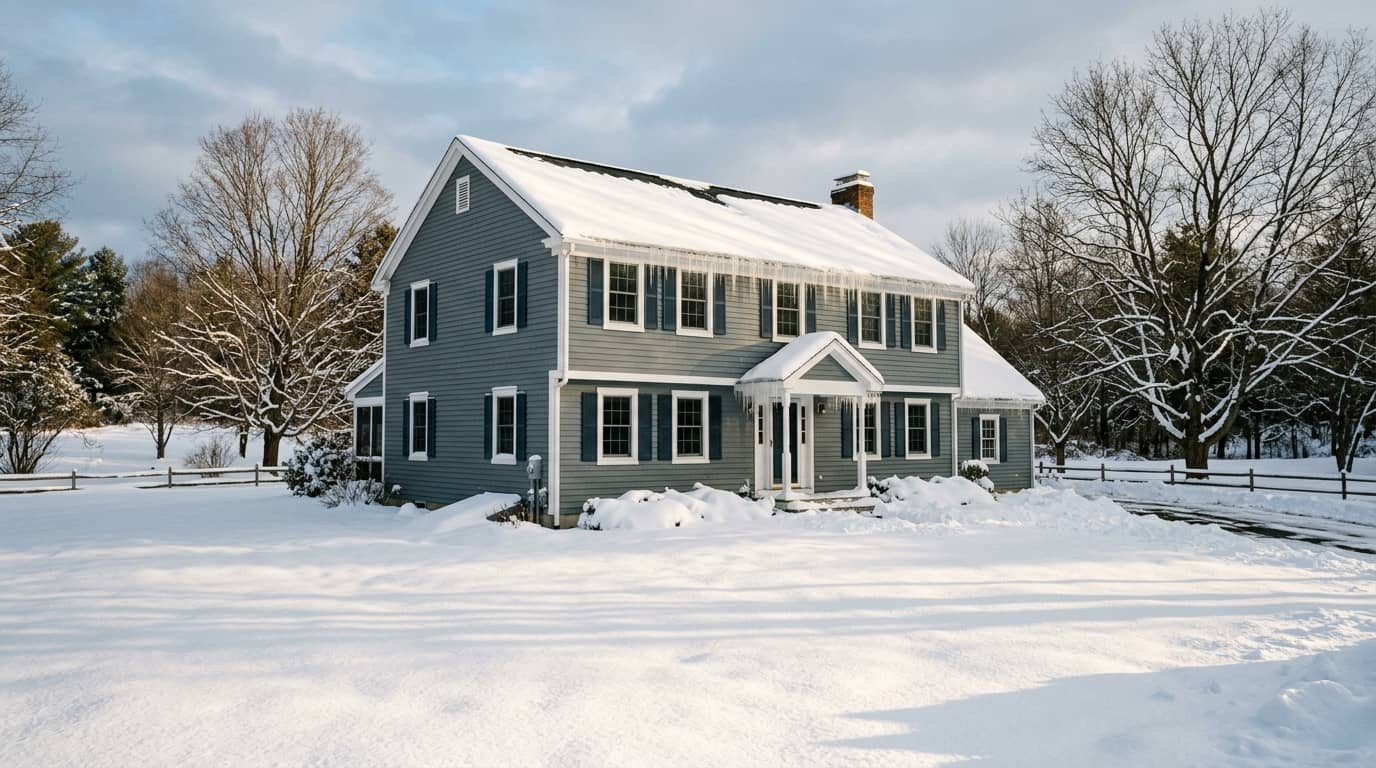
Picture the weather side of your house in February: snow against the bottom courses, a nor’easter driving rain into the seams, a thaw and a hard freeze the same day. That’s the test, and all three materials we install pass it. CertainTeed vinyl, LP SmartSide engineered wood, and James Hardie fiber cement are each built for cold climates. Where they differ is in which winter problem each one is most sensitive to, and how much the installer’s details have to cover for it.
No material wins outright. Fiber cement is the most weather-stable. Vinyl asks the least of you afterward. Engineered wood sits between them and depends most on its finish. On every one, the wall behind the siding does more to get a house through winter than the siding itself, the theme of our full guide to how the three materials hold up in New England.
| Winter threat | Vinyl | Engineered wood | Fiber cement |
|---|---|---|---|
| Cold impact and freeze-thaw | Stiffens in deep cold; a hard hit can crack it. Needs room to move. | Treated to resist it; edges must stay sealed. | Stable; doesn’t absorb water or warp. |
| Snow against the base | Fine with clearance; splash-back rinses off. | Needs clearance and sealed bottom edges. | Needs clearance; otherwise unbothered. |
| Wind-driven rain | Sheds it; the barrier behind does the work. | Sheds it when sealed and painted. | Sheds it; heavy planks resist lift when fastened to spec. |
| Salt air | No corrosion, no paint to protect. | Fine with a kept-up finish and sealed cuts. | Common on exposed shoreline homes. |
| Woodpeckers and insects | Not a food source. | Treated to resist; still wood. | Cement; not a target. |
How do cold and freeze-thaw affect each siding?
Freeze-thaw damages a wall through water: moisture works into a gap, freezes, expands, and pries it wider, then repeats the next night. The cold on its own does far less, which is why the answer differs by material.
Vinyl handles cold well as long as it can move. It contracts as temperatures drop and expands in summer, so the installation manual calls for fastening it loosely in the center of the nail slot and, when installing below 40°F, leaving a wider expansion gap at corners and channels. Vinyl nailed tight buckles in July and can split in January. Said plainly: cold vinyl is stiffer, and a hard impact that would bounce off in summer can crack a panel. Everyday winter does not. If low upkeep is your priority, it’s still the right call for a great many New England homes.
Engineered wood is treated to resist the moisture and freeze-thaw that punish untreated wood, and it holds up strongly here. Its sensitive points are cut edges and joints: where paint or sealant was skipped, water gets into the board and freeze-thaw does the rest. Kept sealed and painted, it is a durable choice.
Fiber cement is the most stable of the three in cold; it doesn’t absorb water, warp, or grow brittle. Its winter demand falls on the crew: heavy planks that need correct clearances and flashing so water never sits at a board end.
What do snow, ice dams, and driven rain do to a wall?
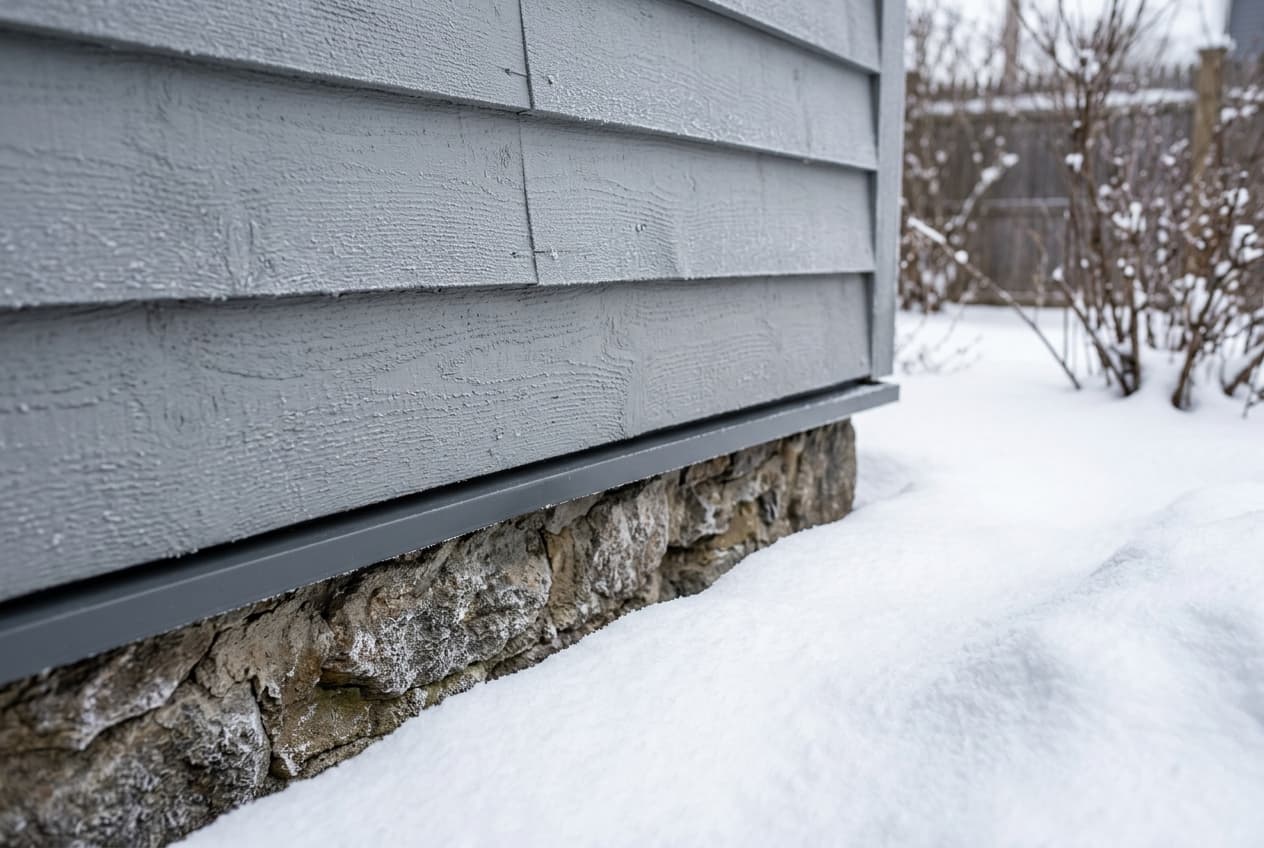
Snow drifted against the bottom courses is the one winter problem that’s the same on every material. Siding that sits in a snowbank for weeks stays wet, and melt-water splashes back up the wall. Every manufacturer calls for clearance between the lowest course and grade, plus a starter strip or drip edge that kicks water away from the foundation. On engineered wood that clearance is not optional.
Ice dams are a roof problem that becomes a wall problem. Attic heat melts snow at the ridge, it refreezes at the cold eave, and the next melt backs up under the shingles and down inside the wall. The siding looks fine while the sheathing behind it stays wet. Our roofing guide covers what ice dams mean for your roof; on the wall side, the house wrap and the flashing where the roof meets the wall are what stop that water short of the framing.
Wind-driven rain is the nor’easter’s contribution: water pushed sideways and upward into seams that shed a gentle rain fine. All three materials shed most of it; none is a sealed shell. The water-resistive barrier and the flashing at every window and door are the actual defense, which is why water getting in behind siding is almost always a detail failure rather than a material one.
Find out how your walls are wintering
Our free in-person assessment checks the weather side, the base of every wall, and the flashing at openings, and tells you honestly what’s holding up.
Get a free siding assessmentWhich siding is best for salt air, coastal wind, and pests?
On the Cape, the South Shore, and the Rhode Island shoreline, winter adds salt spray and steadier wind. That pushes the details harder more than it changes the material choice. Fiber cement is common on exposed shoreline homes because it doesn’t rot, warp, or absorb water and it stands up to impact. Vinyl doesn’t corrode or hold water and has no paint film for salt to lift. Engineered wood does well when its finish is maintained and every cut edge is sealed, which matters more near the water than inland.
What changes on a coastal job is the hardware: corrosion-resistant fasteners, flashing that sheds outward, and panels fastened to the manufacturer’s wind spec are the difference between siding that stays put through a January gale and siding that lifts. Wind ratings on spec sheets are test figures, not warranty terms, and assume the install was done as written.
Pests want wood too. Woodpeckers and carpenter ants go after damp wood-based siding. Engineered wood is treated to resist insects and rot but still wants its edges sealed; vinyl isn’t a food source; fiber cement is cement, and James Hardie warrants its boards against termite damage.
“The winter damage we find is almost never the material giving up. It’s low on the weather side, where snow sat for a month, or at a window where the flashing was lapped backward. Two houses on the same street, same siding, ten years apart in condition. The difference was the crew.”
Global Roofing field team — Massachusetts in-home siding assessments
Why does the install decide more than the material?
Every winter problem above resolves to the wall behind the siding and the details at its edges: house wrap lapped so water runs out, flashing at every window, door, and roof-to-wall line, clearance at the base, fasteners set the way the manual says, cut edges sealed on engineered wood. Get those right and any of the three comes through a New England winter well. Skip them and the best material on the market rots the sheathing behind it. That’s why the installer matters as much as what you pick, and why a cold-weather job is fine with the right crew, as we explain in installing siding in a New England winter.
Choosing between the two ends of the range? Our comparison of vinyl versus fiber cement weighs winter alongside look, upkeep, and budget. If the south wall is what bothers you rather than the north, that’s a sun question, covered in whether vinyl siding fades.
Frequently asked questions
Which siding holds up best to New England winters?
All three we install are built for cold. Vinyl’s weak spot is a hard impact in deep cold; engineered wood’s is unsealed edges; fiber cement’s is a heavy, exacting install. The wall behind the siding decides more than the material.
Does vinyl siding crack in cold weather?
It can on a hard impact, because cold vinyl is stiffer; everyday cold doesn’t crack it. Vinyl also contracts in cold, so the manual calls for loose center-slot fastening and wider expansion gaps below 40°F. Installed that way, it rides out winters for a very long time.
Is fiber cement or vinyl better for a coastal New England home?
Both do well near the water. Fiber cement is common on exposed shoreline homes for its stability; vinyl doesn’t corrode, absorb water, or need paint. Corrosion-resistant fasteners and outward-shedding flashing matter more than the choice.
Can ice dams damage siding?
Indirectly. Water backing up under the shingles can run down inside the wall while the siding looks fine. Ice dams are a roof and ventilation problem first; the wall’s house wrap and flashing keep that water off the framing.
How we wrote this guide
This article reflects what Global Roofing sees on the weather side of real Massachusetts and New England homes, checked against the Vinyl Siding Institute installation manual, LP and James Hardie product and warranty pages, Building Science Corporation guidance on rain control in walls, and National Weather Service winter-weather resources. It was reviewed for accuracy by a licensed Massachusetts contractor on our team. See our full editorial process for how we research and update every article.
Sources
- Vinyl Siding Institute / Polymeric Exterior Products Association — Installation Manual, horizontal siding (fastening, expansion gaps, cold-weather allowances). polymericexteriors.org
- Building Science Corporation — BSD-013: Rain Control in Buildings (why the drainage layer behind cladding does the work). buildingscience.com
- James Hardie — Lifetime Value Siding Products (substrate warranty, hail and termite resistance). jameshardie.com
- LP Building Solutions — The What’s and Why’s of the LP SmartSide 5/50 Limited Warranty (treated strands, hail coverage when installed and maintained to spec). lpcorp.com
- National Weather Service — Winter weather safety: ice and frost (freeze-thaw and ice-dam conditions). weather.gov