

Key Takeaways
- Siding is installed year-round in New England. Cold weather changes the technique, not whether the job can be done.
- Vinyl: below 40°F the installation manual calls for a wider expansion gap at corner posts and channels, loose center-slot fastening, and a fine-tooth blade for clean cuts.
- Fiber cement and engineered wood hang fine in the cold. The limits are on caulk, sealant, and paint, which have minimum application temperatures; factory finishes sidestep most of that.
- The crew works around snow at the base, frozen ground under the staging, and short days, so a winter job may take a few more calendar days.
- Waiting makes sense for a field-painted job or a house with known rot you want opened up dry. Failing siding is rarely a reason to wait.
Can siding be installed in the winter in New England?
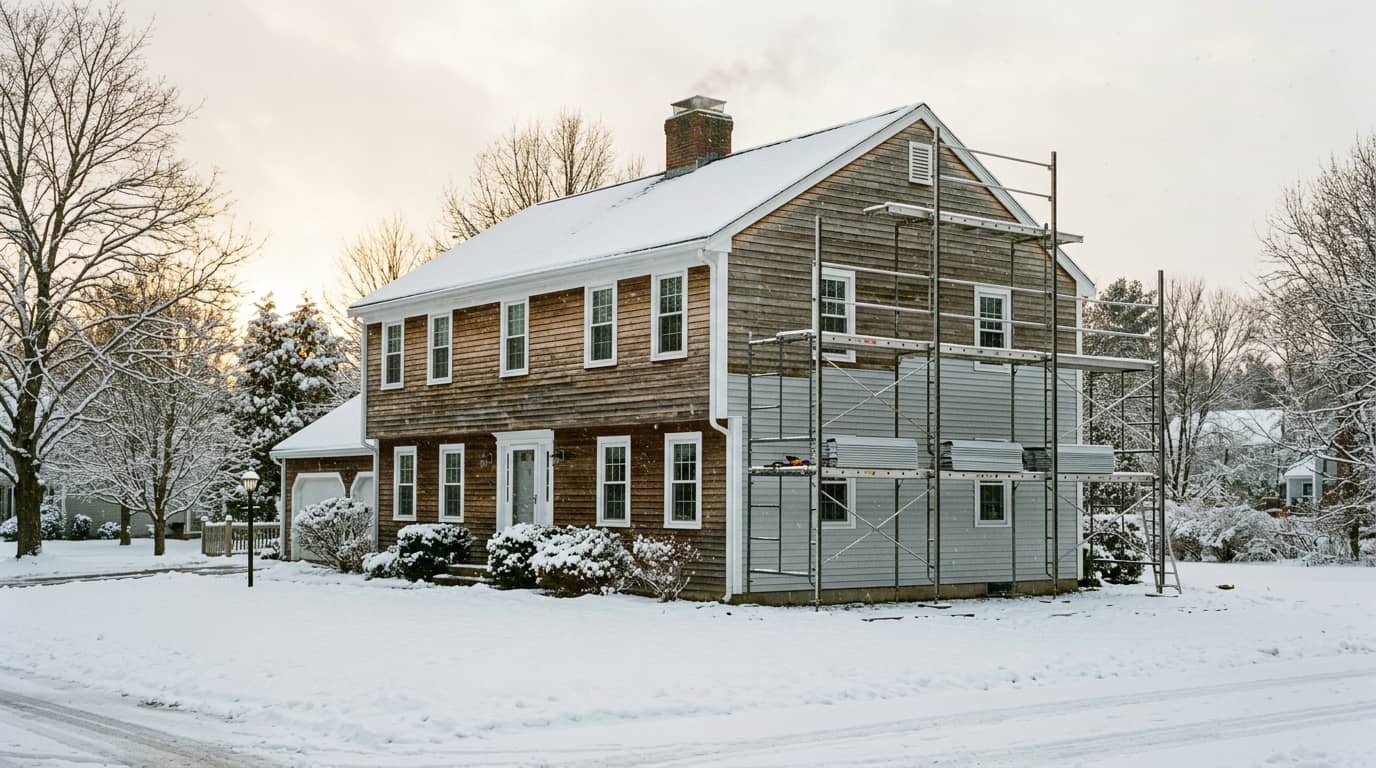
Yes. If your siding is letting water in this February, you don’t have to live with it until May. Vinyl, engineered wood, and fiber cement all go up in cold weather when the crew follows the manufacturer’s cold-weather rules, and in Massachusetts those rules are routine for any team that sides houses for a living.
What changes is the technique and the schedule, not the outcome. The sections below cover what a crew does differently with each material, what the homeowner gets out of a winter start, and the handful of situations where waiting for spring is the better decision. If you’re still deciding whether the siding needs to go at all, start with how to tell whether you need new siding.
What changes when vinyl siding goes up in the cold?
Vinyl moves with temperature more than any other siding. A panel that’s installed at 25°F will be noticeably longer on the first warm day in April, so the whole cold-weather playbook is about leaving it room. The industry installation manual spells it out:
- A wider expansion gap. The standard allowance where panels meet corner posts and channels is 1/4 inch. When installing below 40°F, the manual raises that to 3/8 inch, so the panel has somewhere to go when it warms up.
- Loose fastening, centered in the slot. Nails go in the middle of the nailing slot and stop about the thickness of a dime short of tight. A panel pinned tight in January buckles in July.
- A cleaner cut. Cold vinyl is stiffer and less forgiving. The manual’s advice, a fine-tooth blade run backwards on the saw, exists specifically for smoother cuts in cold weather.
None of that is exotic. It’s the same manual the crew follows in August, with two numbers changed. What you’re really hiring in winter is a crew that knows those numbers without looking them up, which is one more reason the installer matters more than the season.
What about fiber cement and engineered wood in winter?
Fiber cement and engineered wood don’t expand and contract the way vinyl does, and both are built for freeze-thaw once they’re on the wall. Hanging the boards in the cold is not the issue. The limits are on the wet products that go with them:
- Caulk and sealant. Every joint and trim intersection gets sealed, and sealants carry a minimum application temperature set by the sealant maker. LP’s instructions, for example, point installers to the sealant manufacturer’s rules for a paintable, non-hardening exterior sealant. The crew checks the product, not the calendar.
- Paint and touch-up. Primed products need field paint, and LP’s own instructions say touch-up paint goes on only when the air, the siding, and the paint are all above 50°F. That’s the number that stalls a winter job.
- Factory finishes change the picture. James Hardie’s ColorPlus finish is cured onto the boards at the factory, and LP offers prefinished lines. With a factory finish, there’s no field painting waiting on a warm day, which is why prefinished products are the usual winter choice for these materials.
Know what happens, and when
The Siding Project Planning Timeline lays out every step from the first assessment to the final walk-through, so you can see where a winter schedule stretches and where it doesn’t.
Get the timeline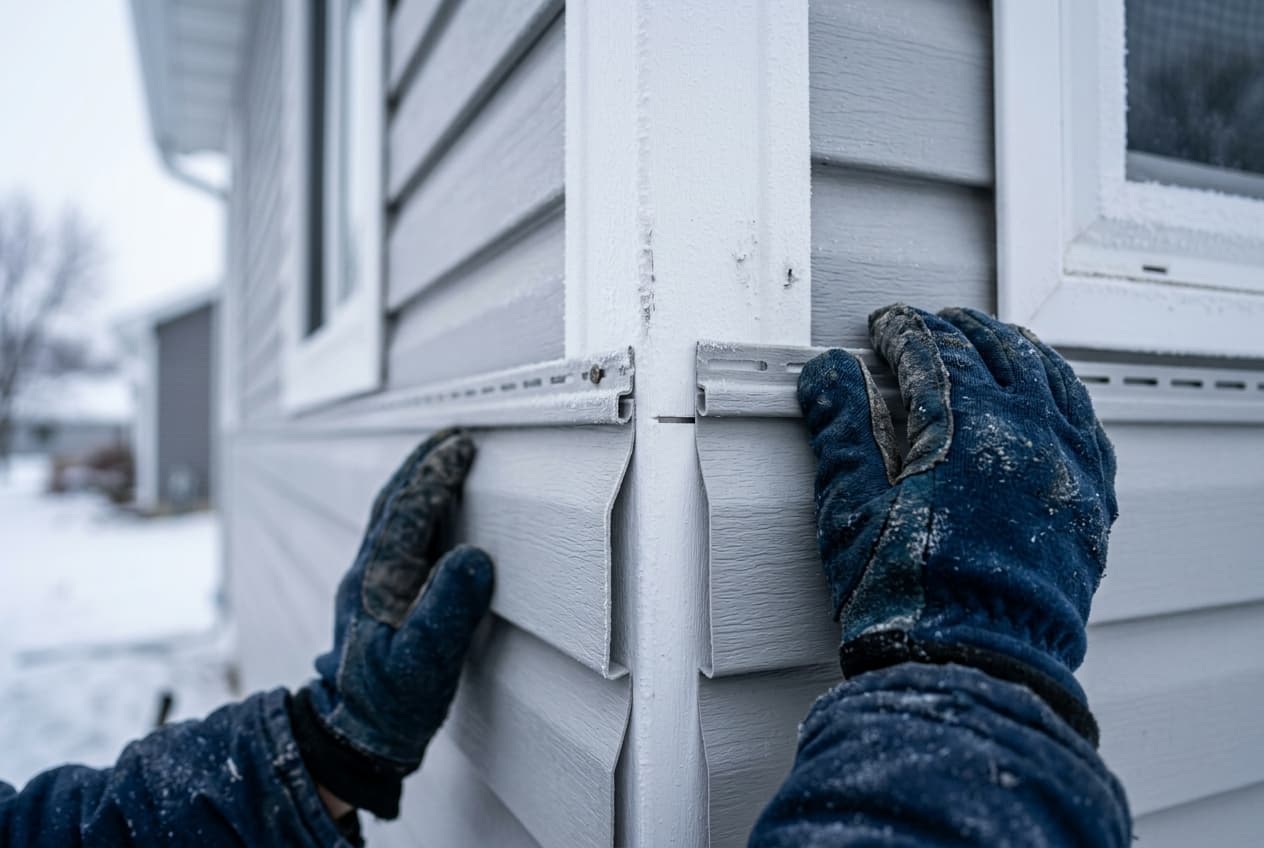
What does the crew do differently in winter?
Most of the winter adjustments happen on the ground, not on the wall. Snow gets cleared from the base of the house before the bottom courses go on, because the lowest siding and the trim along the foundation are where trapped moisture does its damage. Staging goes up on frozen or thawing ground, which means more time on footing and leveling. Short days shrink the working window, so a job that runs four days in June can run five or six in January.
Materials get managed too. Panels stay stacked and covered until they’re cut, sealant tubes stay somewhere warm until they’re used, and the crew watches the forecast for the days that need caulk. Your written scope should describe all of this the same way it describes the house wrap and flashing; we cover what belongs in the paperwork in what a siding contract should include. For how the calendar shifts overall, see how long siding installation takes.
| Material | Winter install | What changes |
|---|---|---|
| Vinyl | Routine | 3/8-inch expansion gap below 40°F, loose center-slot fastening, fine-tooth blade for cuts. |
| Engineered wood (LP SmartSide) | Routine for prefinished; primed waits on paint | Sealant follows the maker’s minimum temperature; touch-up paint only above 50°F per LP. |
| Fiber cement (James Hardie) | Routine for ColorPlus; primed waits on paint | Factory finish avoids field painting; caulk still follows the sealant maker’s temperature limit. |
“The only thing a winter job really costs you is a couple of extra days. The thing a leaking wall costs you through February is the sheathing. When a homeowner asks whether they should wait, that’s the comparison I put in front of them.”
Global Roofing field team — Massachusetts in-home siding assessments
Why not just wait until spring?
You can, and some homeowners should. But the reasons people assume they have to wait mostly don’t hold up. The wall is open for a few days in any season, and the water-resistive barrier goes on the same day the old siding comes off; a July thunderstorm is no kinder to an open wall than a January flurry. Winter schedules are also easier to get, since spring and fall are when everyone calls.
The bigger point is what the siding is doing while you wait. If it’s cracked, loose, or letting water past the trim, a full winter of freeze-thaw against the sheathing is the expensive path, not the install. Our article on whether water is getting in behind your siding walks through the signs. And because New England weather is the backdrop to every material decision, not just the winter ones, it’s worth reading what holds up in New England before you pick a product.
How each material performs once winter actually arrives is in which siding holds up best to New England winters.
When is waiting for spring the smarter call?
Three situations, honestly stated. First, a job that depends on field painting: primed fiber cement or engineered wood that you’re planning to have painted on site will sit primed until the temperature cooperates, and a long gap between install and paint is not what the manufacturer wants. Choose a factory-finished product or wait. Second, a house with known rot: if you already expect soft sheathing behind the old siding, dry spring conditions make the repair cleaner and the inspection easier. Third, a bid that can’t explain the cold. If a contractor can’t tell you what changes in their process below 40°F, that’s a reason to keep looking, in any season. Our full guide to hiring a siding contractor covers the questions that surface it.
Frequently asked questions
Can vinyl siding be installed in cold weather?
Yes. Below 40°F the installation manual calls for a 3/8-inch expansion gap at corner posts and channels instead of 1/4 inch, loose fastening in the center of the nail slots, and a fine-tooth blade for cleaner cuts. Cold vinyl is stiffer, so it wants a crew that follows those rules rather than forcing it.
Is winter a bad time to replace siding?
Not by itself. The wall is open for a few days in any season and winter schedules are easier to get. What matters is the product and the crew: vinyl and factory-finished boards install well in the cold, while field paint and caulk have minimum application temperatures that can stall a job.
Does cold weather affect the siding warranty?
Only if the install ignores it. Manufacturer warranties depend on installation to the written spec, and the cold-weather rules are part of that spec. A winter install done to spec carries the same warranty as a June one; a rushed install in any season can void it.
Should I wait until spring to replace failing siding?
Usually not. Siding that’s letting water into the wall does more damage over a New England winter than a winter install ever would. Wait for a field-painted job, a house with known rot you want opened up dry, or a bid that can’t explain how the crew handles the cold.
How we wrote this guide
This article reflects how Global Roofing crews install siding through Massachusetts and New England winters, checked against the Vinyl Siding Institute installation manual’s cold-weather rules, LP SmartSide installation instructions, and James Hardie’s published guidance on ColorPlus finishes and cold-climate performance. It was reviewed for accuracy by a licensed Massachusetts contractor on our team. See our full editorial process for how we research and update every article.
Sources
- Vinyl Siding Institute / Polymeric Exterior Products Association — Vinyl Siding Installation Manual, horizontal siding installation (expansion gaps, cold-weather allowance, fastening). polymericexteriors.org
- Vinyl Siding Institute / Polymeric Exterior Products Association — Installation Manual, getting started (cutting in cold weather, fastener clearance). polymericexteriors.org
- LP Building Solutions — LP SmartSide ExpertFinish installation instructions (sealant requirements, touch-up paint temperature). lpcorp.com
- James Hardie — ColorPlus Technology: the facts behind the finish (factory-cured finish) and best siding for cold winter climates (freeze-thaw performance). jameshardie.com