

Key Takeaways
- Dark siding works in New England. It suits a farmhouse, a contemporary, or any house with enough white trim to balance it, and it’s a common request at our assessments.
- A dark color absorbs more heat. On vinyl that means more expansion, so the color has to come from the manufacturer’s own dark palette, and the crew has to give the panels room to move.
- Never paint vinyl darker than its factory color. It voids the warranty and can warp the panel. Choose dark from the start instead of painting toward it.
- Dark shows more: snow spray, road salt, pollen, dust, and eventual fade. Fiber cement and engineered wood with a factory finish carry deep colors most easily; vinyl carries them within its dark-color lines.
- The choice most people actually face is Bold Darks versus Soft Grays. Seeing both on a model of your own house settles it faster than any color chip.
Should you commit to dark siding in New England?
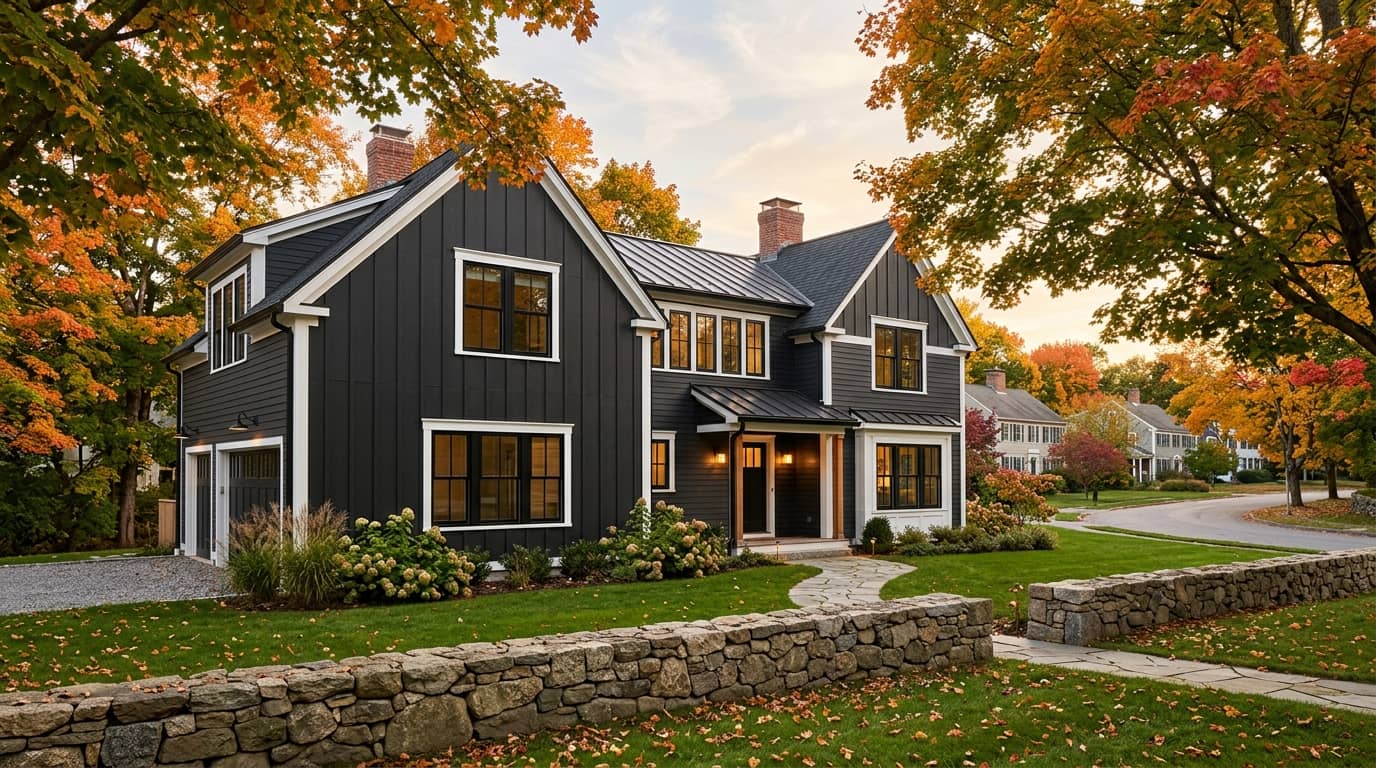
You saved the photo months ago. A black farmhouse, wide white trim, black windows, a gable drawn with a ruler. Now it’s your turn to pick a color, and the question is whether that house works on a street in Massachusetts.
It can. Dark siding isn’t a mistake here, and it isn’t a free pass either. A deep color changes how the walls take heat and how they look after a February storm. Here’s what we’d tell you at the kitchen table, starting from the pillar’s rules for choosing a siding color.
Why are dark exteriors having a moment, and where do they work?
Contrast, mostly. A black or charcoal field (the field is the main wall color) makes white trim look crisp and turns ordinary windows into graphic shapes. Dark also calms a busy elevation: too many bump-outs and rooflines read simpler in one deep tone.
It works best on a modern farmhouse, where dark board and batten is the whole idea, on a contemporary with clean lines, and on any house with generous white trim to break it up. It struggles on a small house with narrow trim in a shaded lot, where dark reads heavy instead of bold. If you’re in a local historic district, the commission approves materials and colors before the permit, so check your town’s guidelines first.
What does a dark color do on a house in our climate?
Four things, none of them a reason to walk away — each a reason to choose the material and the color carefully.
Heat and movement. A dark surface absorbs more sun. On fiber cement or engineered wood that means the finish works harder. On vinyl the panel gets warmer and expands more. The Vinyl Siding Institute’s manual has installers fasten loosely and leave clearance at every opening because vinyl can grow and shrink half an inch or more across a twelve-foot run in a normal year. A dark panel on a south or west wall sits at the top of that range, so the install matters more, not less.
Never paint vinyl darker. The one hard line. Painting over a factory vinyl finish voids the manufacturer’s warranty, and Sherwin-Williams, which sells paint for vinyl, explains why: dark paint absorbs the sun’s heat and passes it into the panel, and vinyl that expands too far can’t contract back to shape. In vinyl, black has to come from the manufacturer’s own palette.
Snow, salt, and pollen. Dark walls show what lands on them. Snow spray along the foundation, road salt near the street, and spring pollen all stand out against charcoal the way they never would against cream. A rinse once or twice a year fixes it.
Fade over time. Every color softens under sun, and a deep color has more pigment to lose, so change shows first on the sunny side. How each material fades, and what the warranties count as fade, is covered in does vinyl siding fade. This article is about the decision.
How does each siding material carry a dark color?
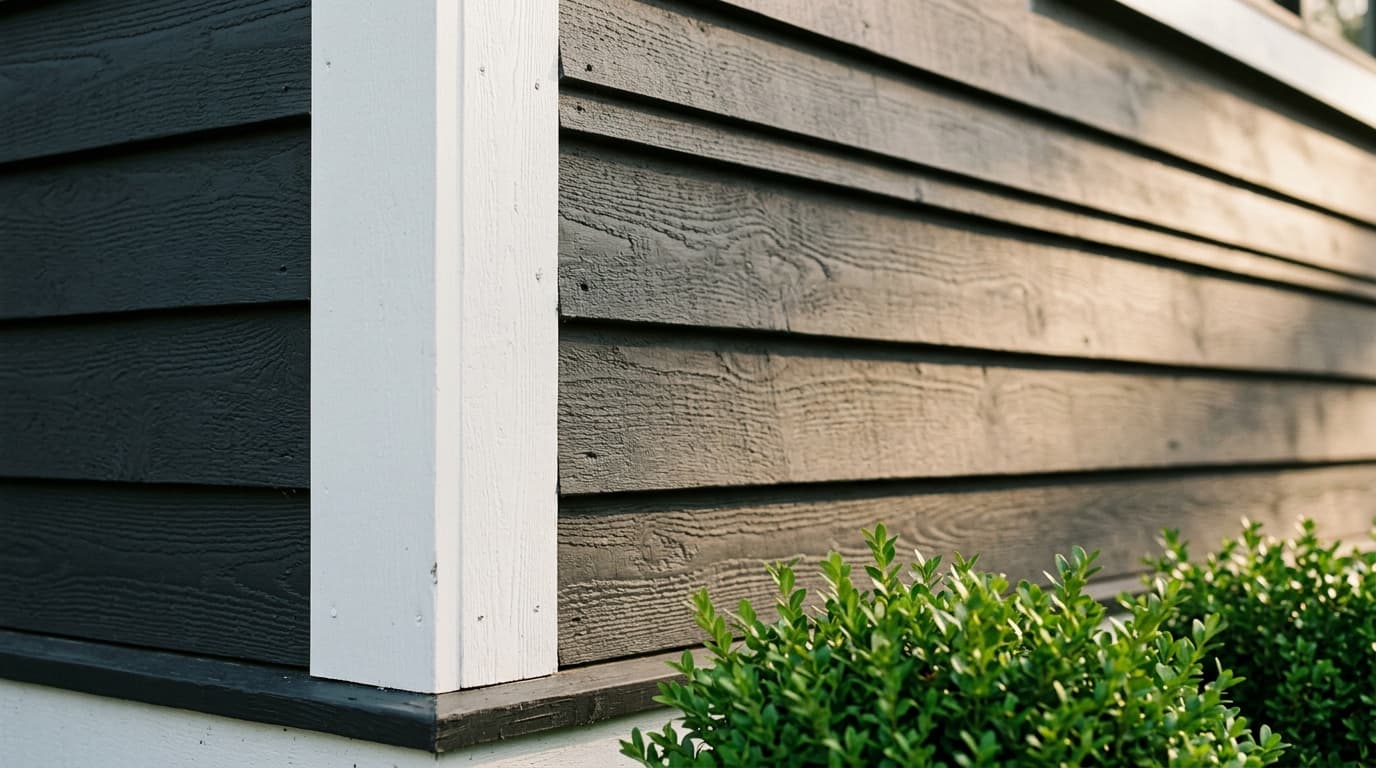
By fit, not by ranking. All three materials we install can be dark, but they get there differently.
Vinyl (CertainTeed) carries color through the panel, so there is no film to peel and nothing to repaint. The catch is that dark comes only from the manufacturer’s own palette, which CertainTeed describes as fade-resistant and built for mixing and matching across lines. Pick from the current color card for the line you want: Monogram clapboard, Board & Batten for the farmhouse look, or CedarBoards. Our guide to which CertainTeed vinyl line fits your home sorts the lines by look.
Engineered wood (LP SmartSide) takes dark the way wood does: a factory prefinish in a deep tone, cured before it reaches your house. That coat holds color longer than field paint, and a repaint brings the board back.
Fiber cement (James Hardie) is what most people picture when they picture a black house. The board doesn’t care about heat, and the ColorPlus factory finish carries deep colors evenly. It can be repainted later, which also means it eventually will be.
| Material | How it carries a dark color | What to watch |
|---|---|---|
| Vinyl (CertainTeed) | Color through the panel; only within the manufacturer’s dark-color palette | More expansion on sunny walls; never painted darker |
| Engineered wood (LP SmartSide) | Factory prefinish in deep tones | Plan on a repaint someday; keep it off the snow line |
| Fiber cement (James Hardie) | ColorPlus factory finish; carries black and charcoal evenly | Heavier install; a repaint eventually restores the finish |
What does dark siding done well look like?
Three moves account for almost every dark house you’ve admired.
- A dark field with wide white trim. The farmhouse formula. The trim has to be substantial: wide corner boards, wide casings, a real band at the roofline. Narrow trim disappears against black and the house loses its edges.
- Dark below, lighter above. A charcoal lower story under a Soft Grays or Whites & Creams upper grounds the house and keeps it from looming. How to split the two is covered in two-tone siding.
- Dark trim on a light field instead. If you love the black-window look but not a black house, reverse it: a light field with black casings, corners, and door. Same contrast, none of the heat and upkeep questions. The pairings are in siding and trim color combinations.
All three depend on the roof, the one thing you can’t change on siding day. A black roof over a black house needs a break, usually white trim and fascia, or the two read as one dark mass from the street. A weathered-gray or brown roof over charcoal is easier, as long as the temperatures agree: cool with cool, warm with warm. Matching siding color to your roof, brick, and stone goes fixture by fixture.
“Nobody regrets the black house because of the color. They regret it when the trim is skinny, or when someone painted old vinyl to get there. Buy the dark color made for the material, give it real trim, and it holds up like anything else we put on.”
Global Roofing field team — Massachusetts in-home siding assessments
Bold Darks or Soft Grays: which decision are you really making?
Almost nobody at our table is choosing between black and beige. They’re choosing between a Bold Darks field and a Soft Grays one: the striking house and the one that’s still striking but forgiving. Bold Darks wins on contrast. Soft Grays hides pollen and salt, stays broadly appealing to the next owner, and leaves room to go dark on the door and shutters instead. Which colors travel well is covered in which siding colors hold their value.
A color chip can’t settle it. A charcoal square held up at noon says nothing about a full north wall in November. What settles it is seeing a Bold Darks field next to a Soft Grays version on your own house, one total for each.
Find your style, then see it on your own house
TruFit is a two-minute survey that tells you which siding style fits your home and your taste. TruPro then puts it on a 3D model of your actual house — mix and match styles, colors, and trim and watch one total update as you go. Both are part of our free in-person siding assessment.
Schedule a free assessmentFrequently asked questions
Is dark siding a bad idea in New England?
No. It works on plenty of Massachusetts homes, especially a farmhouse or contemporary with wide white trim. Buy the dark color from a palette the manufacturer built for it, and expect it to show snow spray, salt, and pollen more than a mid-tone.
Does black vinyl siding warp in the sun?
Vinyl of any color moves with temperature, and a dark panel absorbs more heat, so it moves more. Manufacturers formulate dark colors for that, and a crew that fastens loosely and leaves clearance gives them room. The real trouble is vinyl painted darker than its factory color, or sunlight concentrated off a neighbor’s windows, which distorts light and dark siding alike.
Can you paint vinyl siding black?
Not safely. Painting over a factory vinyl finish voids the warranty, and paint brands warn against going darker than the original color because the added heat can warp the panel. Choose a dark color made for the material from the start.
Which siding material is best for a dark color?
It depends on what you want to maintain. Fiber cement and engineered wood with a factory finish carry deep colors easily and can be repainted later; vinyl carries dark within the manufacturer’s palette and never needs paint.
How we wrote this guide
This article reflects what Global Roofing sees on dark-sided homes across Massachusetts and New England, checked against the Vinyl Siding Institute’s installation manual and solar-reflection research, CertainTeed’s published vinyl color guidance, and Sherwin-Williams’ guidance on painting vinyl. It was reviewed for accuracy by a licensed Massachusetts contractor on our team. See our full editorial process for how we research and update every article.
Sources
- Vinyl Siding Institute — Vinyl Siding Installation Manual (expansion and contraction, fastening, clearances). polymericexteriors.org
- Polymeric Exterior Products Association — Vinyl Siding Solar Reflection (distortion from reflected sunlight affects light and dark siding alike). polymericexteriors.org
- CertainTeed — Vinyl Siding (fade-resistant color palette designed for mixing and matching across lines). certainteed.com
- Sherwin-Williams — Vinyl Siding Warping: Causes and Solutions (why vinyl should not be repainted darker than its original color). sherwin-williams.com