

Key Takeaways
- Choose the siding color last, around the things that aren’t changing: the roof, brick, stone, a stone foundation, and any door you’re keeping.
- Every common roof color has a set of siding palettes that tend to sit well under it. A black roof takes almost anything; a brown roof wants warm siding; a weathered-wood blend forgives more than either.
- With brick or stone, pull a secondary tone from the mortar or the lighter flecks rather than matching the dominant color.
- Trim is the bridge between roof and siding. It can carry the contrast so the field color doesn’t have to.
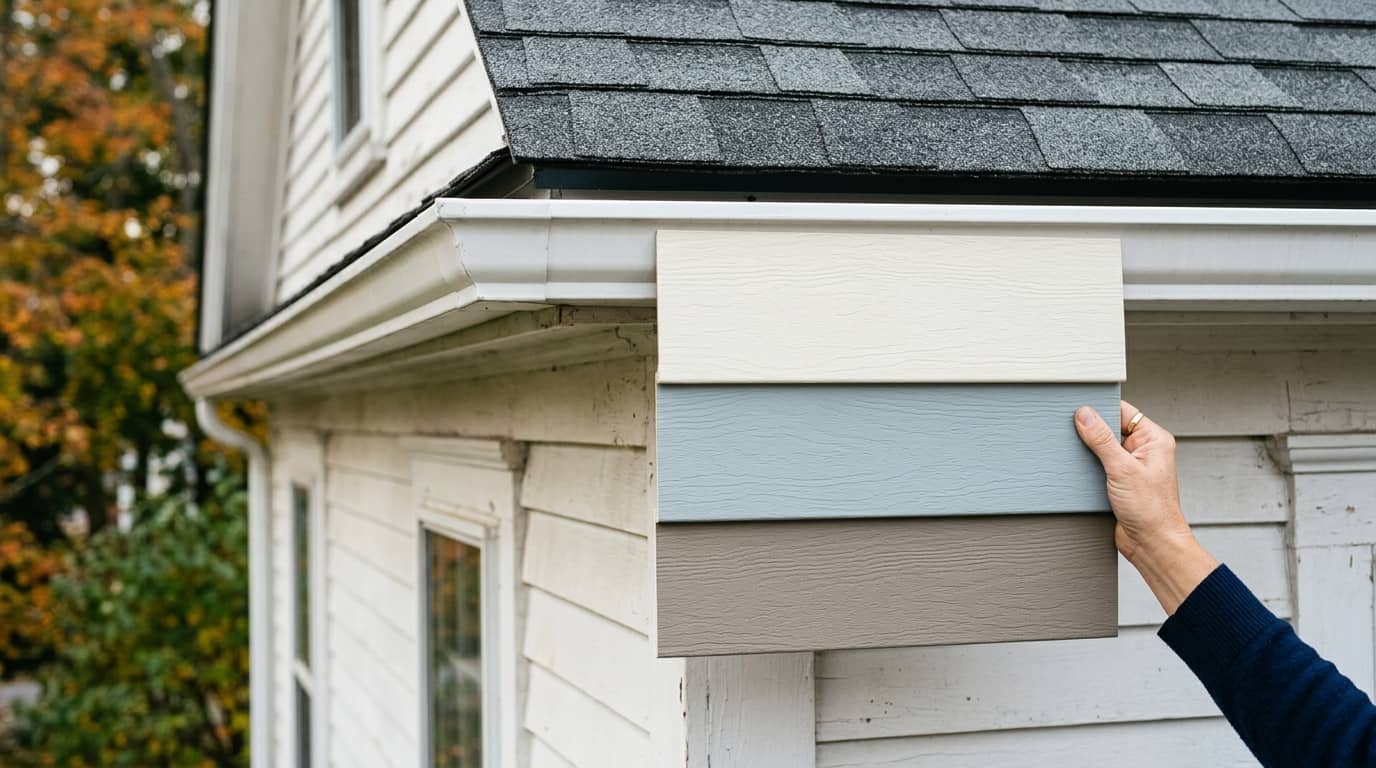
- A chip looks different on the wall because of light. Big samples, on the actual wall, north and south sides, noon and evening.
What should you decide first when picking a siding color?
You’ve narrowed it to a handful of chips and one looks perfect on the kitchen table. Before it goes further, walk outside and look up. The roof is the largest surface on most homes, the first thing the eye lands on from the street, and it isn’t changing. Neither is the brick chimney, the fieldstone foundation, or the front door you’re keeping.
That’s the whole method: list what stays, then choose a siding color that agrees with it. Our guide to choosing a siding color sets the rule that covers most cases: match the temperature. Warm roofs and masonry (browns, tans, reds) with warm siding; cool ones (blacks, grays, blues) with cool. Here it is fixture by fixture.
Which siding colors go with each roof color?
Asphalt roofs come in a short list of colors, and each has siding palettes that sit well beneath it. The palette names below are the ones TruFit uses.
- Black or charcoal. Cool, neutral, the most forgiving roof there is. Whites & Creams read crisp under it; Soft Grays and Coastal Blues share its temperature. A Bold Darks field can go striking or heavy, and wide white trim is what tips it toward striking, as our piece on dark siding in New England explains.
- Weathered gray. Cool, with more texture. Soft Grays, Coastal Blues, and Whites & Creams settle in; warm tan looks borrowed from another house.
- Brown. Warm, and the least flexible. Cool blue-gray under a brown roof is the mismatch we see most often.
- Weathered wood. Browns and grays in one shingle, so it holds both temperatures and forgives.
- Red or green. Usually metal or clay-look on an older home. The roof is already the color, so siding does best receding.
| Roof color | Siding palettes that tend to work | Trim |
|---|---|---|
| Black or charcoal | Whites & Creams, Soft Grays, Coastal Blues, tan-leaning Warm Naturals, Bold Darks with a break | White, or black on a light field |
| Weathered gray | Soft Grays, Coastal Blues, Whites & Creams | White or a deeper gray |
| Brown | Warm creams, Warm Naturals (tan, sage, warm green), brown-undertone grays | Cream or warm white |
| Weathered wood | Warm Naturals, Whites & Creams, warm Soft Grays, muted Coastal Blues | White, cream, or a deep brown |
| Red or green | Whites & Creams; a quiet Warm Natural | White; let the roof be the color |
None of this is a verdict on your house. It’s the set of combinations that read as planned more often than not, which is where James Hardie’s color guidance lands too.
Find your style, then see it on your own house
TruFit is a two-minute survey that tells you which siding style fits your home and your taste. TruPro then puts it on a 3D model of your actual house — mix and match styles, colors, and trim and watch one total update as you go. Both are part of our free in-person siding assessment.
Schedule a free assessmentTruPro’s model includes your actual roof, so every palette is judged against what you’re keeping, from the street and the backyard.
How do you pick a siding color to go with brick or stone?
Brick and stone are never one color. Red brick carries rust, brown, a little purple, and pale mortar between every course. Fieldstone runs gray, tan, and rust in the same rock. That makes them easier to work with than they look, as long as you don’t try to match them.
Pull a secondary tone instead. The mortar is the most reliable: a siding color in the mortar’s family (a warm cream, a soft gray, a pale tan) ties the brick to the wall without competing. On stone, the lighter flecks do the same job. Matching the dominant brick color reads heavier, and a cool blue next to warm red brick makes both look wrong.
A stone foundation works the same way, only lower: warm stone under a Warm Naturals or cream field, gray stone under Soft Grays or Coastal Blues. CertainTeed’s color guidance calls this the undertone, the quieter pigment underneath a color. It’s the undertone, not the color name, that decides whether siding and masonry agree.
What does trim do between the roof and the siding?
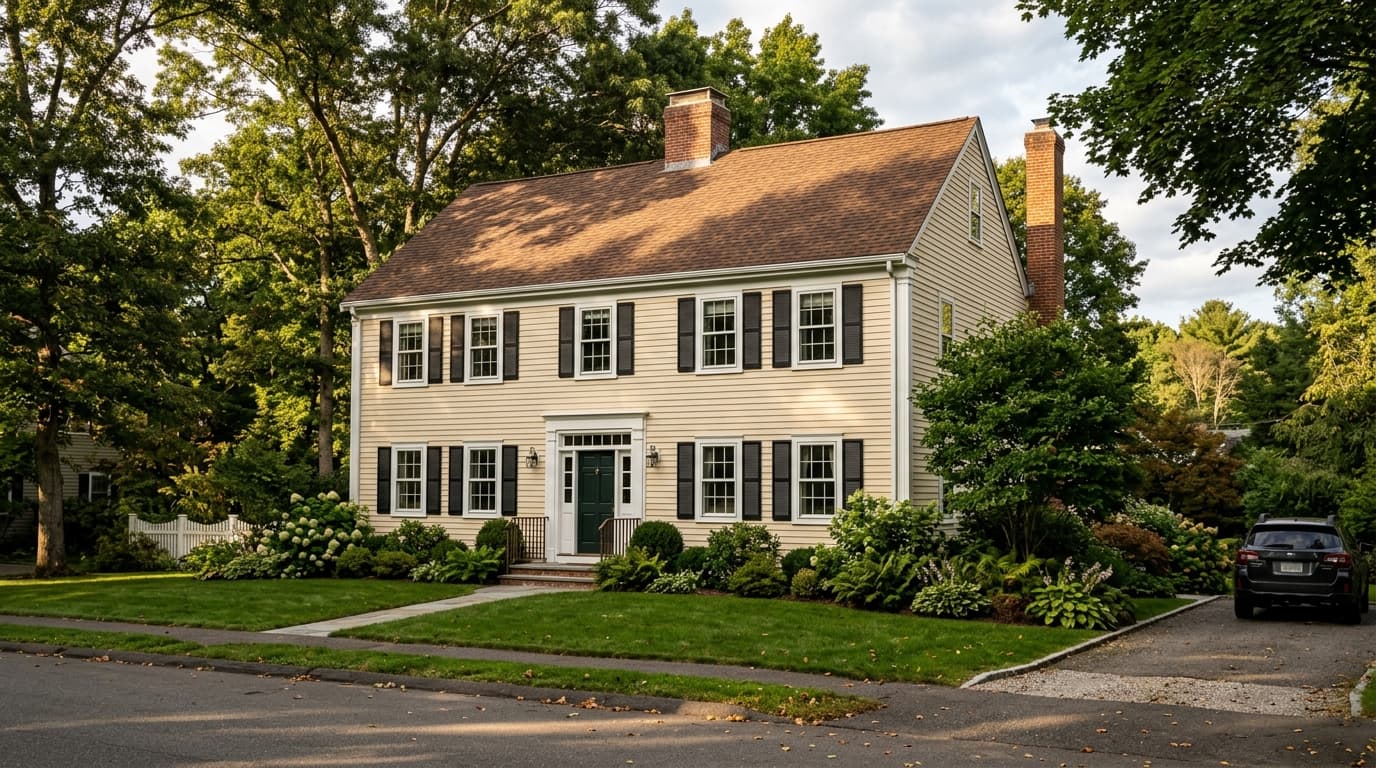
Trim, meaning the corner boards, window casings, and the fascia along the roof edge, is the bridge. When roof and siding share a temperature they can look flat together; trim in a lighter or darker value gives the eye a place to rest. It’s why white trim under a charcoal roof feels finished, and why cream often beats bright white under a brown one.
Trim also lets the field stay quiet: if the siding agrees with the roof, the trim, shutters, and door can do the contrasting. Siding and trim color combinations goes through the pairings palette by palette.
“The color question we get asked most is ‘does this gray go with my roof?’ And the honest answer is that we can’t tell from the chip either. We hold the big sample on the north wall under the roof line, then walk it around to the south side, and half the time the homeowner answers their own question.”
Global Roofing field team — Massachusetts in-home siding assessments
Why does the chip look different on the wall?
Because a color isn’t fixed. It’s light bouncing back, and how much bounces back changes with the light hitting it. Paint makers call this light reflectance value and score it from 0 (absorbs everything) to 100 (bounces everything back). A pale cream throws a lot of light at you, a charcoal very little, and a mid-tone gray lands wherever the sky puts it.
Three things move it on a real house:
- Which way the wall faces. North-facing walls get indirect light all day, so colors read cooler and grayer. South-facing walls get direct sun and read lighter and warmer. The same siding can look like two products on one house.
- Time of day. Noon light is bright and neutral; evening goes warm, then blue, and a gray that looked clean at noon can go cold by dinner. Sherwin-Williams makes the same point: as the day moves from sunrise to dusk, a color’s appearance moves with it.
- What’s next to it. A charcoal roof pulls a soft gray cooler; red brick pushes a cream warmer. The chip in the store had a white counter under it.
The fix is unglamorous: the biggest samples you can get, on the actual wall, under the roof line, north and south sides, noon and evening.
What if you’re re-siding now and replacing the roof later?
Then the roof you have is still the one you’re designing around, even if it’s tired. A faded brown roof is still warm; a streaked black roof is still cool. Choosing siding for a roof five years out means living with a mismatch.
The way through is a siding color that works with the current roof and keeps the next one open. Whites & Creams and warm Soft Grays do this most reliably, because a future black, gray, or weathered-wood roof all sit well over them, which is part of why they appear in siding colors that hold their value. If both are near the end of their life, replacing the roof and siding at the same time covers when that makes sense; one advantage is choosing both colors on one model.
Frequently asked questions
What siding color goes with a black roof?
Almost anything, which is part of why black is so common. Whites & Creams read crisp under it, Soft Grays and Coastal Blues share its cool temperature, and a Bold Darks field can work when wide white trim breaks up the dark surfaces.
What siding color goes with a brown roof?
Warm siding: a warm cream, tan, sage, a warm green, or a gray with a brown undertone. A cool blue-gray under a brown roof is the pairing that most often reads as a mismatch, because the temperatures fight.
Should siding match the brick on a house?
Coordinate, don’t match. Pull a siding color from one of the quieter tones in the brick, usually the mortar, and let the brick be the strong color. Matching its dominant color makes the wall look heavier, not more planned.
Why does my siding sample look different on the house than in the store?
Light. A chip is judged indoors at arm’s length; siding is judged in daylight from the street, next to a roof that pulls it warmer or cooler. North walls read cooler, south walls lighter, and evening shifts it again. Large samples on the actual wall close most of the gap.
How we wrote this guide
This article reflects how Global Roofing works through color with homeowners at in-home siding assessments across Massachusetts and New England, checked against James Hardie’s guidance on house and roof color combinations, Sherwin-Williams’ explanations of light reflectance value and how light changes color, and CertainTeed’s ColorCoach color-theory guidance. It was reviewed for accuracy by a licensed Massachusetts contractor on our team. See our full editorial process for how we research and update every article.
Sources
- James Hardie — How to Match House and Roof Color Combinations (warm with warm, cool with cool; the common roof colors). jameshardie.com
- Sherwin-Williams — Worthy of Reflection (light reflectance value and the 0–100 scale). sherwin-williams.com
- Sherwin-Williams — The Play of Light and Color (how orientation and time of day change how a color appears). sherwin-williams.com
- CertainTeed — ColorCoach: Color Theory (warm and cool colors, undertones, coordinating siding with trim and accents). certainteed.com