


Key Takeaways
- The questions that matter most are about what goes behind the siding — house wrap, flashing, and what happens if rot turns up — because that is where siding jobs succeed or fail.
- Ask who will actually be on your house and who you call a year later. Subcontracted crews can be excellent; you are checking accountability, not skill.
- A good estimate is one total plus a full written description of the company, the scope, and the materials by brand and line — never a line-item split.
- Good answers are specific and in writing. “We handle all that” is the answer to press on.
What should you ask about the siding company?
You are hiring the company that will still be around when a corner board comes loose in year six, so start there. Four questions, and the answers you want to hear:
- Are you registered and insured in Massachusetts? Can I see both? A good answer is a home improvement contractor registration number you can look up and a current certificate of insurance (a COI — the one-page proof of coverage) showing general liability and workers’ compensation. We walk through both in what license and insurance a siding contractor should have.
- Who will actually be on my house? A good answer names the crew — employees trained to the company’s own specification, or a subcontractor the company has used for years and insures. Either can be fine. What you are listening for is whether the person selling the job knows who is installing it; the tradeoffs are in in-house crew vs. subcontractors.
- Can I see recent work nearby? A good answer is addresses you can drive past and homeowners you can call, from the last year or two, not a decade ago. Our designers can pull up a map of finished projects near you, with the crew’s own photos.
- Are you certified by the siding manufacturer? A good answer names the credential and what it means: the crew installs to the manufacturer’s written specifications, which is what keeps the product warranty intact.
What should you ask about what’s behind the siding?
This is the group most homeowners skip, and it is the one that decides whether the wall stays dry. Siding is the outer layer of a system; the layers behind it do the real work.
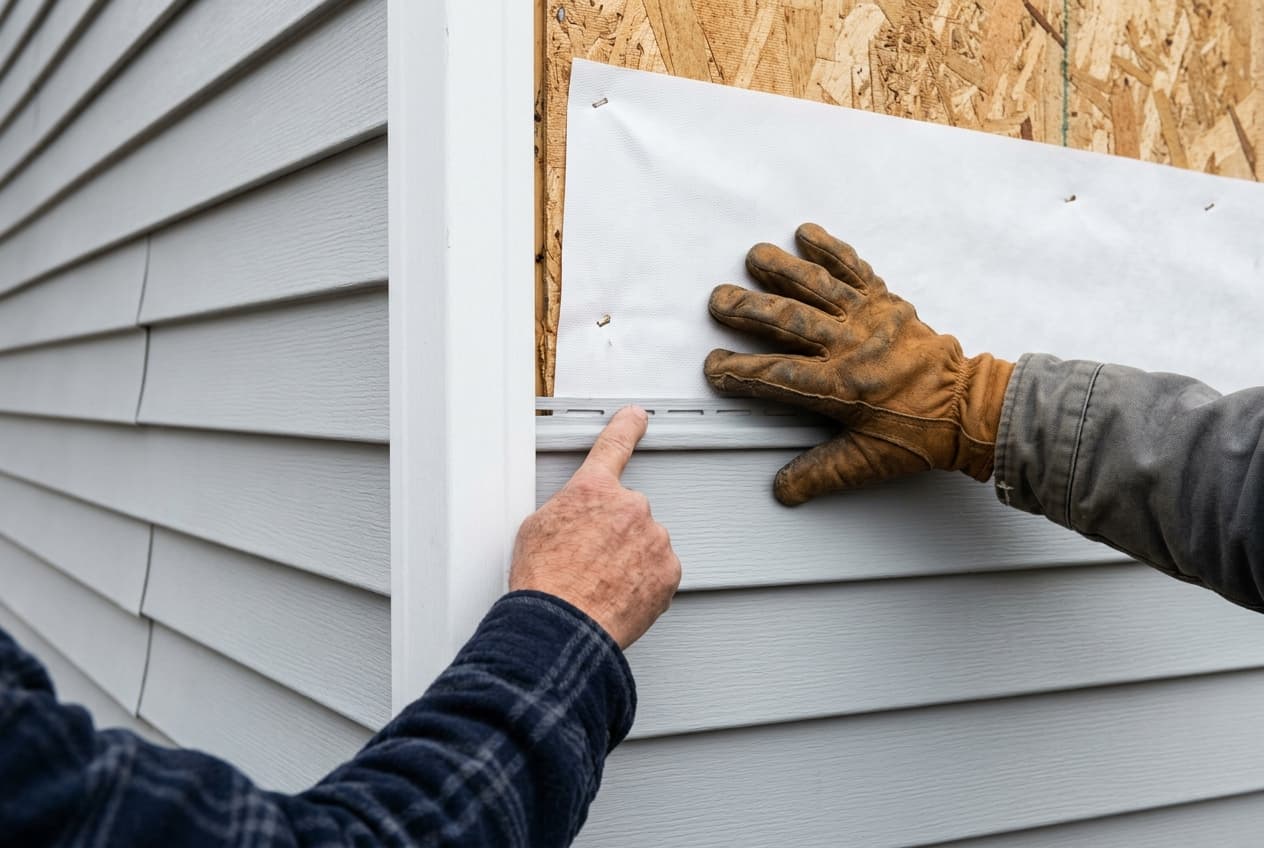
- What goes on the wall before the siding? A good answer, unprompted: a new water-resistive barrier (house wrap) over the sheathing, flashing at every window and door, and kick-out flashing where a roof meets a wall. A contractor who only talks about the panels is selling you the visible half of the job. Why those layers matter is the subject of how water gets in behind siding.
- What happens if you find rot once the old siding is off? A good answer describes a process: they stop, show you, price the repair in writing, and nothing changes without your signature. “We’ll deal with it” is not a process. The full list of what can surface is in the hidden costs of a siding project.
- Exactly which product are you installing? A good answer is a brand and a product line, not a material. “Vinyl” is a category; a named line is something you can look up. Our materials guide covers the three we install and who each one fits.
What should you ask about the scope, the total, and the schedule?
- Will I get the full scope in writing, with one total? A good answer is yes: a single total price plus a written description of the company standing behind the work, the exact scope, and the materials by brand and product line. That is the document you compare quotes on. You do not need — and should not expect — a line-by-line split of materials versus labor.
- How long will it take, and how many people? A good answer gives a window in days for your house, explains what could stretch it, and tells you whether the same crew stays on the job start to finish. The factors are in how long siding installation takes.
- How will you protect the property and clean up? A good answer covers plantings, decks, and AC units; where the dumpster goes; daily cleanup; and a magnet sweep for nails at the end.
Score every quote on the same page
Our printable siding estimate checklist turns these questions into a scorecard you fill out for each contractor — so you compare scope against scope, not just the bottom lines.
The warranty answers you should expect, brand by brand, are in siding warranties compared.
Get the checklistWhat should you ask about warranties and what happens after?
- What does the product warranty cover, and what do you cover? A good answer separates the two: the manufacturer covers defects in the material, and the contractor’s own workmanship warranty covers the install. Ask for both in writing, and ask what the workmanship warranty runs. How to read an estimate’s warranty language is in the hiring guide’s section on estimates.
- Who do I call if something is wrong in a year? A good answer is a name and a number at the company, not “the crew.” This is where the crew question comes back around; see why the cheapest bid often has no one to call.
“The question I wish more people asked is ‘what’s under it?’ Anyone can hang a panel. Whether the wall is dry in ten years comes down to the wrap and the flashing, and you only find out if you ask before the siding goes on.”
Global Roofing field team — Massachusetts in-home siding assessments
Can you see it on your house before you sign?
One last question, and it is a fair one now: can I see this on my own house first? With us, the answer is yes. TruFit is a two-minute survey that tells you which siding style fits your home and your taste. TruPro then puts it on a 3D model of your actual house — every wall, window, and roofline — where you mix and match styles, colors, and trim and watch one total update as you go. The number you sign is the number you get, and the crew builds from that same design. Both are part of our free in-person assessment; the whole path is in how to get a custom siding design and quote. Whoever you hire, the pattern holds: good answers are specific and written down, and the full guide to hiring a siding contractor covers what to do with them.
Frequently asked questions
What is the most important question to ask a siding contractor?
Ask what goes on the wall before the siding does. A contractor who answers with specifics — house wrap, flashing at every opening, kick-out flashing at roof-to-wall lines, and a process for rot found behind the old siding — is thinking about the wall as a system. One who only talks panels and colors is selling the visible half of the job.
Should I ask a siding contractor whether they use subcontractors?
Yes, plainly: who will be on my house, and who do I call a year from now? Subcontracted crews can be excellent. You are checking accountability — whether the company trains the crew to its own specification, insures it, and backs the result with its own workmanship warranty.
Should a siding estimate be itemized by materials and labor?
No. A good estimate is one total price plus a full written description of the company, the exact scope, and the materials by brand and product line. A materials-versus-labor split looks precise but says little about quality; a detailed scope is what lets you compare two quotes fairly.
How do I know if a siding contractor’s answers are good ones?
Good answers are specific and in writing: the wrap and flashing details, the product line by brand, the crew on site, the process for anything found behind the old siding. “We handle all that” is the answer to press on, and a question that gets one answer from the salesperson and another from the crew lead is a flag.
How we wrote this guide
This article reflects the questions homeowners ask us at real Massachusetts and New England siding assessments — and the ones we wish they would — checked against the Massachusetts home improvement contractor requirements, Better Business Bureau guidance on hiring a contractor, and Vinyl Siding Institute installation standards. It was reviewed for accuracy by a licensed Massachusetts contractor on our team. See our full editorial process for how we research and update every article.
Sources
- Massachusetts Office of Consumer Affairs — Home Improvement Contract Requirements (registration numbers, written contracts, and what must appear in them). mass.gov
- Better Business Bureau — Hiring a Contractor (references, insurance, and written agreements). bbb.org
- Vinyl Siding Institute — Installation standards (water-resistive barrier, flashing, and fastening requirements). vinylsiding.org
- Consumer Reports — Siding Buying Guide (materials and what to ask before you buy). consumerreports.org