

Key Takeaways
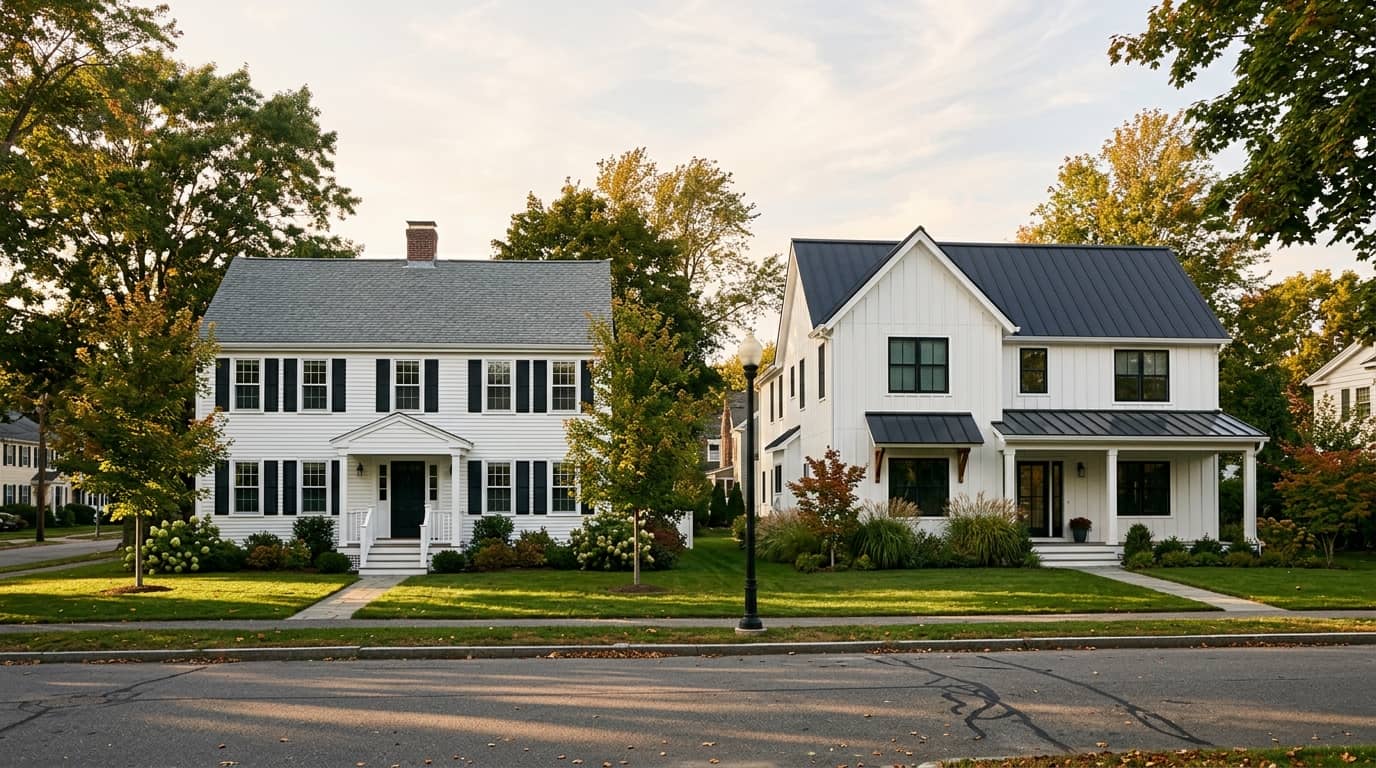
- Lap siding is horizontal boards, each overlapping the one below. It reads quiet and traditional and is the default on most Massachusetts streets.
- Board and batten is wide vertical boards with narrow strips over the seams. It reads tall and architectural, and it’s the profile behind the modern farmhouse look.
- Let the house lead: a colonial or Cape wants lap; a farmhouse, a contemporary, or a gable-forward front carries board and batten well.
- The usual answer is both: lap on the main walls, board and batten in the gables or at the entry, meeting at a trim band.
- Classic Clapboard and Modern Farmhouse are two of TruFit’s style directions, and TruPro shows either one on your own walls before you decide.
Board and batten or lap: which one fits your house?
You saved a photo of a white farmhouse with tall vertical boards and black windows. Your house is a colonial with clapboard. The question is whether that look belongs on your walls.
Let the bones of the house decide. Lap suits almost every home in New England because most were drawn for it. Board and batten suits height, a strong gable, or a modern plan. On most designed exteriors the two share the job. Our guide to siding profiles covers all four; this one goes deep on these two.
What’s the difference between lap siding and board and batten?
Lap siding is long horizontal boards, hung bottom up so each course overlaps the one below. The overlap sheds water. The visible part of each board is the exposure: a narrow exposure gives a wall more lines, a wide one fewer. This Old House traces clapboard to colonial New England; the name comes from a Dutch word for splitting, since the first boards were split from logs by hand.
Lap is a family, not one look. Clapboard is a flat board with a plain overlap, so the wall reads as even lines. Dutch lap adds a curved notch along the top of each course, which throws a deeper shadow line — the dark stripe under each board — and gives the wall more depth. CertainTeed’s Monogram line comes in both and calls the look traditional and timeless.
Board and batten runs the other way: wide vertical boards set edge to edge, with a narrow strip called a batten over every seam. On old barns the batten kept wind out of the gap; today it makes the wall. CertainTeed’s vertical vinyl comes in 7-inch and 8-inch Board & Batten profiles and a wider CedarBoards version, and reverse board and batten flips the proportion to narrow boards and wide battens. Which material to build it from is a separate question, answered in board and batten in vinyl, engineered wood, and fiber cement.
How does each look from the street?
Horizontal lines make a house feel longer, lower, and settled. That’s why lap reads quiet and traditional: the eye moves across the front, and the windows and door do the talking. A lap house in Whites & Creams or Soft Grays never looks like it’s trying.
Vertical lines lift a wall. Board and batten reads tall and architectural because every batten draws the eye up to the roofline. James Hardie’s design guidance puts it the same way: tall, wide panels give a clean, unadorned look typical of contemporary homes, and the battens turn that into a rustic farmhouse feel. Battens set wide apart read modern; set tight in a gable peak, they read hand-built.
Neither is better. Lap disappears into the street; board and batten announces the house. Classic Clapboard and Modern Farmhouse are two of TruFit’s style directions, and TruPro shows both on your own walls before you pick.
Find your style, then see it on your own house
TruFit is a two-minute survey that tells you which siding style fits your home and your taste. TruPro then puts it on a 3D model of your actual house — mix and match styles, colors, and trim and watch one total update as you go. Both are part of our free in-person siding assessment.
Schedule a free assessmentWhich houses suit each look?
A profile that fits the house reads as designed; one that fights it reads as a renovation that tried too hard. The pillar’s profile-by-house-style guide covers five styles; here is where these two land.
| Look | Reads as | Suits | Common pairing |
|---|---|---|---|
| Clapboard | Quiet, even, traditional | Colonials, Capes, Garrisons, ranches | White trim and shutters; battens in a gable |
| Dutch lap | Traditional, with more shadow | The same houses, when plain lap feels flat | Wider trim so the detail doesn’t read busy |
| Board and batten | Tall, architectural, farmhouse or modern | Farmhouses, contemporaries, a gable-forward front | Black windows, wide white trim, a stone skirt |
| Lap below, battens above | Designed, layered, still traditional | Almost any house with a visible gable or dormer | A trim band between them; one color or two |
Classic Clapboard is the direction for a colonial or a Cape. Those houses are wide and low, their windows sit in a symmetrical grid, and horizontal boards hold that composition together. Full-height battens across a colonial’s front fight the windows and stretch the proportions in a way that looks off without anyone being able to say why.
Modern Farmhouse is the direction for a farmhouse, a contemporary, or any house whose front is dominated by a gable. A gable is a triangle of wall, and vertical boards fill it more naturally than lap courses that shorten toward the peak. For a shingled Cape near the water, the coastal cousin of this decision is in shake and shingle siding for the New England coast.
Do you have to choose just one?
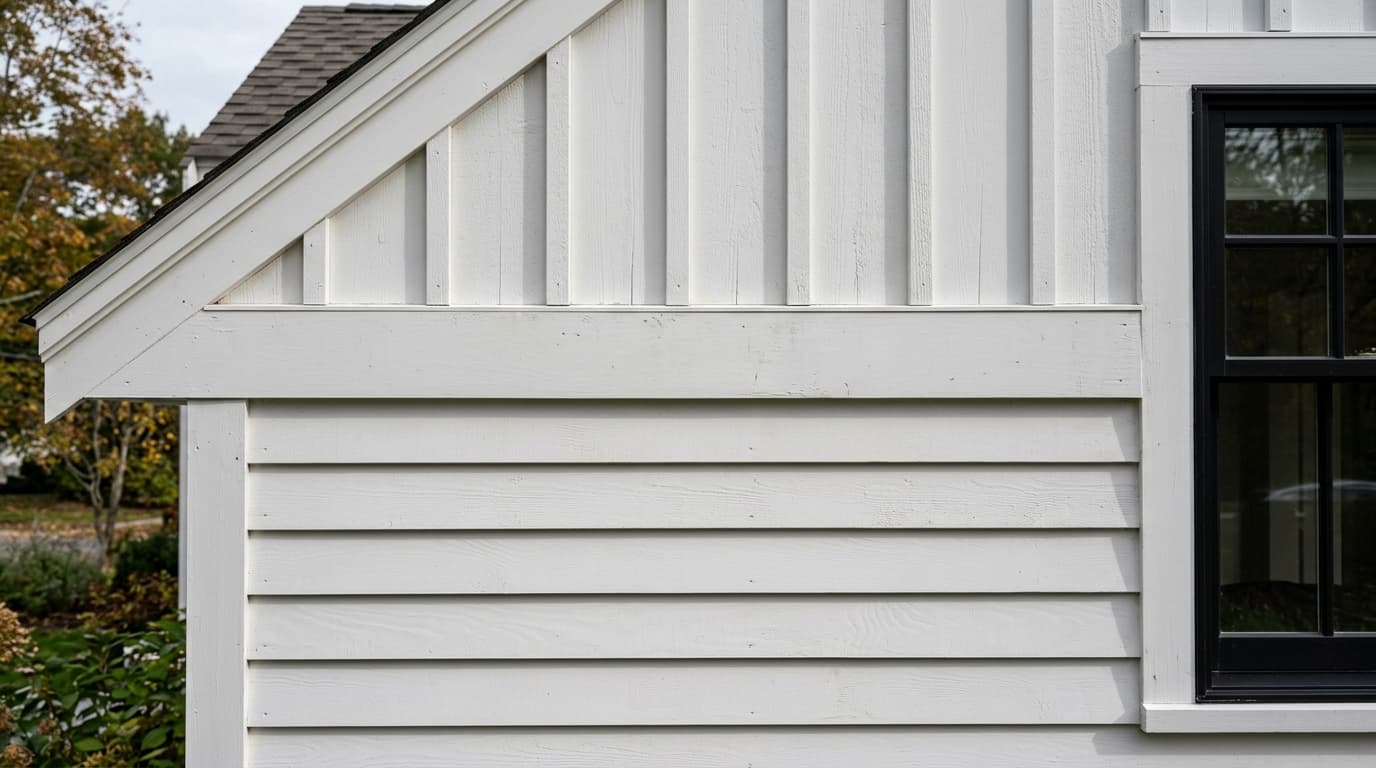
No, and most designed exteriors don’t. The common combination here is lap on the main walls with board and batten in the gables, dormers, or entry wall. CertainTeed says the same of its vertical siding: it’s usually mixed with other profiles as an accent in gables and bump-outs. James Hardie’s designers add that pairing battens with lap keeps a house from reading as a single trend.
Both profiles come in every material we install, so the mix stays within one brand and one warranty, and because a gable is a small share of the wall the accent adds a little, not a lot. More combinations are in mixing lap, board and batten, and shake on one house. In TruPro that mix is built wall by wall — clapboard below, board and batten above — with one total that updates as you go.
“The photo people bring us is almost always a full board-and-batten farmhouse. The house they own is almost always a colonial or a Cape. Nine times out of ten the right move is battens in the gable and over the front door, lap everywhere else — the thing they liked in the photo, without turning their house into a different house.”
Global Roofing field team — Massachusetts in-home siding assessments
What changes at the trim, corners, and windows?
The two profiles differ at the edges, and that’s where a design is won or lost.
- Corners. Lap ends at a corner post or corner board. Battens can do the same, or one can sit at the corner so the rhythm turns without a break. A wide corner board reads designed; a thin one reads builder-grade.
- Where the profiles meet. Lap below and battens above need a horizontal trim band, sometimes with a small ledge that kicks water out over the lap. Its width sets the tone.
- Windows. Lap runs into the side casing and stops. Battens run down onto the head trim and up from the sill, so that trim usually wants to be wider — and a good installer lands the battens evenly beside each opening rather than crashing into a casing.
The pairings that make those details work are in siding and trim color combinations that work, and CertainTeed’s vinyl siding lines shows which line carries each profile. Trim style and width for every opening, and corners that match or contrast, are choices TruPro sets on your actual windows.
Frequently asked questions
What is the difference between Dutch lap and clapboard siding?
Both are horizontal lap. Clapboard is a flat board with a plain overlap, so the wall reads as even lines. Dutch lap adds a curved notch along the top of each course that throws a deeper shadow line and more depth. Clapboard is the quieter of the two, and both fit the same houses.
Does board and batten siding look right on a colonial?
Usually not as the main siding. A colonial’s proportions were drawn for clapboard, and vertical boards across the front fight the symmetry of the windows. It works in a small dose: a gable, a dormer, or an entry surround, with lap elsewhere.
Can you put board and batten on just the gables?
Yes, and it’s one of the most common ways New England homes use it. Battens in the gables or dormers with lap below gives a house the farmhouse detail without changing its character, and both profiles can come from the same product family.
Is board and batten more expensive than lap siding?
As an accent, it adds a little, not a lot. It costs more per area than plain lap, but a gable is a small share of the house. Board and batten on every wall is a whole-house profile decision and prices like one. Size and the whole-house material are what move a siding price.
How we wrote this guide
This article reflects how Global Roofing designs and installs lap and vertical siding on real Massachusetts and New England homes, checked against CertainTeed’s vertical and Monogram siding pages, James Hardie’s exterior design guidance on siding styles and board and batten, and This Old House’s coverage of clapboard. It was reviewed for accuracy by a licensed Massachusetts contractor on our team. See our full editorial process for how we research and update every article.
Sources
- CertainTeed — Vertical Siding (Board & Batten profiles, CedarBoards board and batten span, vertical siding as a gable and bump-out accent). certainteed.com
- CertainTeed — Monogram vinyl siding (clapboard and Dutch lap styles, low-gloss wood-grain finish). certainteed.com
- James Hardie — The Essential Guide to Board and Batten Siding (batten spacing, gable accents, pairing with lap). jameshardie.com
- James Hardie — The 3 Essential Siding Styles (lap, vertical, and shingle siding, and how each reads). jameshardie.com
- This Old House — How to Hang Clapboard Siding (clapboard since colonial times, the word’s origin, exposure and overlap). thisoldhouse.com