

Key Takeaways
- The quick formula: expected lifespan − current age, then adjust up or down for condition.
- Use the material’s real-world New England lifespan as your baseline — about 22–28 years for architectural asphalt shingles.
- Don’t know the age? Permit records, the layer count, the shingle style, and a past inspection report can all narrow it down.
- Ventilation, sun exposure, install quality, and ice-dam history can move the number by years in either direction — when you’re close to the edge, get a professional read.
How do you estimate how many years a roof has left?
The simplest honest method has three steps: start with a baseline, subtract the age, then adjust for condition. You won’t get a guaranteed date, but you’ll get a realistic window — enough to know whether to relax, watch, or start planning.
Step 1 — Start with the expected lifespan. Every roofing material has a typical service life. For the architectural (dimensional) asphalt shingles on most New England homes, plan on roughly 22 to 28 years in this climate; older, flatter 3-tab shingles run shorter. Our breakdown of how long an asphalt roof actually lasts here explains where those numbers come from and why our winters trim a few years off the wrapper rating. Use that as your baseline.
Step 2 — Subtract the current age. Take the baseline and subtract how many years the roof has been on the house. A 25-year baseline on a 16-year-old roof leaves you with a rough estimate of about nine years. That number is your starting point, not your answer.
Step 3 — Adjust for condition. This is where the estimate gets real. Push the number up if the attic is well ventilated, the roof was installed correctly the first time, and the slopes stay dry. Pull it down if the attic is hot and sealed, a southern exposure bakes in the sun, the roof has a history of ice dams, or it was a layover put on over an old layer. Each of those can shift the estimate by years.
Think of the result as a band rather than a date. If it lands comfortably in the future, you’re in monitor mode. If it lands in the next few years, it’s time to plan. And remember — age is the starting point, not the verdict; a sound older roof may have more life in it than the math suggests, which is exactly the question behind whether an old roof really needs replacing.
Want this done for you?
Our 2-minute Roof Condition Assessment takes the same inputs — your roof’s age and what you’re seeing — and turns them into a straight read: monitor, plan ahead, or get it looked at.
Take the assessmentWhat if I don’t know how old my roof is?
Plenty of homeowners inherit a roof and have no idea when it went on — especially if they bought the house. You can usually pin the age down close enough to work with:
- Building-permit records. A re-roof usually needs a permit. Your town or city building department often keeps these on file, sometimes searchable online, with the date the work was done.
- Your closing or inspection report. The home-inspection report from when you bought the house frequently notes the roof’s estimated age or remaining life. Dig it out of the closing paperwork.
- The layer count. Look at a roof edge or peek in the attic. A single layer points to one roof; a second layer tells you there’s been at least one re-roof — and that the top layer is a layover, which matters for lifespan.
- The shingle style. Thin, flat 3-tab shingles suggest an older roof; thicker, dimensional shingles point to a more recent one. The profile alone narrows the era.
- Neighbors and date stamps. In a same-builder neighborhood, homes were often re-roofed around the same time, so a neighbor’s known date is a useful clue. Some manufacturers also print a date code on the shingle or its wrapper, occasionally still legible in the attic.
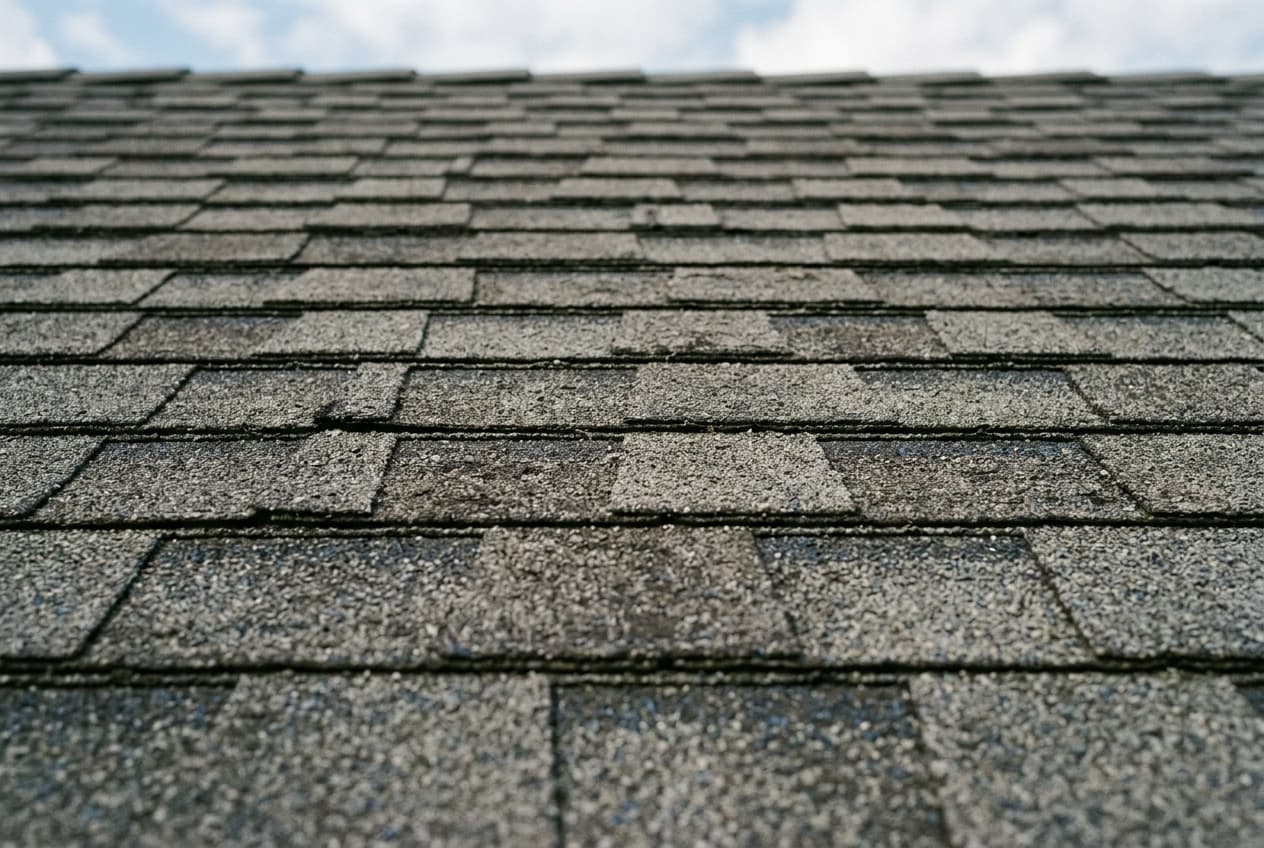
If none of that lands, a roofer can usually estimate the age from how the shingles have weathered — granule loss, brittleness, and the look of the seal strips all tell a story.
What speeds up or slows down the clock?
The adjustment step is where most of the accuracy lives, so it helps to know which levers actually move the number. These are the same forces that decide why two roofs the same age can be years apart in condition:
- Attic ventilation — the biggest lever. When intake at the soffits and exhaust at the ridge are balanced, the roof deck stays cool and dry and the shingles age at their natural pace. A sealed, hot, humid attic bakes them from below and can shave years off the estimate.
- Sun and orientation. South- and west-facing slopes take the most UV and heat and tend to wear first; shaded slopes age slower — as long as they stay dry.
- Shade and moss. Heavy shade that keeps a slope damp invites moss and algae, which lift shingle edges and hold water against the roof. Helpful for sun, costly for moisture.
- Install quality. A roof done right the first time earns its full range. A rushed job, or a layover laid over an old layer to skip the tear-off, commonly gives out early.
- Ice-dam history. Repeated ice dams force melt-water back under the shingles and wear the eaves long before the field of the roof is spent.
You don’t have to re-derive all of this — the asphalt-lifespan guide covers each driver in depth. Here, just use them to nudge your estimate up or down a few years.
“Homeowners do the age math fine. Where they’re off is the attic — they can’t see the ventilation, so they don’t adjust for it. Two roofs the same age, one’s got five good years left and the other’s done. The deck tells us which is which.”
Global Roofing field team — Massachusetts in-home estimates
When should you get a professional read?
A do-it-yourself estimate is great for orientation, but a few moments call for a trained eye on the roof — and underneath it. Get a professional read when:
- Your estimate lands in the watch-closely window. If the math puts you in the last several years of the expected range, a roofer can tell you whether you have time to plan or less than you think.
- You’re buying or selling. A roof’s remaining life is a real number in a home sale, and both sides benefit from a straight answer rather than a guess.
- You’re considering solar. Panels are meant to stay put for decades, so they want a roof with plenty of life left — usually well under 15 years old, or freshly replaced. Estimating the roof’s remaining life first saves an expensive mistake; our guide on putting solar on an older roof covers where that line falls.
- A storm just came through. Wind and hail can age a roof in an afternoon, and the damage isn’t always visible from the ground.
The reason to have a pro look isn’t the shingles you can see — it’s the roof deck and the attic ventilation you can’t. That’s where most of the real remaining-life story is written. Our free in-person inspection checks all of it, and our Roof Condition Assessment is a fast first step if you’re not ready to schedule one. For the bigger picture of how all the signs add up, the pillar guide on deciding whether you need a new roof ties it together.
Frequently asked questions
How do I estimate how many years my roof has left?
Start with the material’s expected lifespan — about 22–28 years for architectural asphalt shingles in New England — and subtract the roof’s current age. Then adjust: good ventilation, a quality install, and dry slopes push the number up, while a hot unvented attic, heavy sun, ice-dam history, or a layover pull it down. The result is a realistic window, not a guaranteed date.
What if I don’t know how old my roof is?
Check building-permit records at your town or city hall, the home-inspection report from when you bought the house, and the number of shingle layers at a roof edge. The shingle style hints at the era, neighbors in same-builder neighborhoods often re-roofed around the same time, and a roofer can estimate age from how the shingles have weathered.
What speeds up or slows down how fast a roof ages?
Attic ventilation is the biggest factor — a sealed, hot attic bakes shingles from below, while balanced venting lets them age at their natural pace. Sun exposure, install quality, repeated ice dams, and a damp, mossy slope all shorten life; a clean install and good airflow extend it.
When should I have a professional check my roof?
When your estimate lands in the watch-closely window, before buying or selling a home, before adding solar (which needs a roof with years of life left), or after a major storm. A roofer checks the deck and attic ventilation you can’t see from the ground, which is where the real answer usually is.
How we wrote this guide
This article reflects what Global Roofing sees on real Massachusetts and New England roofs, checked against National Roofing Contractors Association guidance on roofing service life and attic ventilation, InterNACHI inspection standards on roof age and condition, and manufacturer specifications. It was reviewed for accuracy by a licensed Massachusetts roofing contractor on our team. See our full editorial process for how we research and update every article.
Sources
- National Roofing Contractors Association — roofing system service life and attic ventilation guidance. nrca.net
- InterNACHI — standards for estimating roof age and assessing roof condition during inspections. nachi.org
- Asphalt Roofing Manufacturers Association — asphalt shingle performance and ventilation. asphaltroofing.org