

Key Takeaways
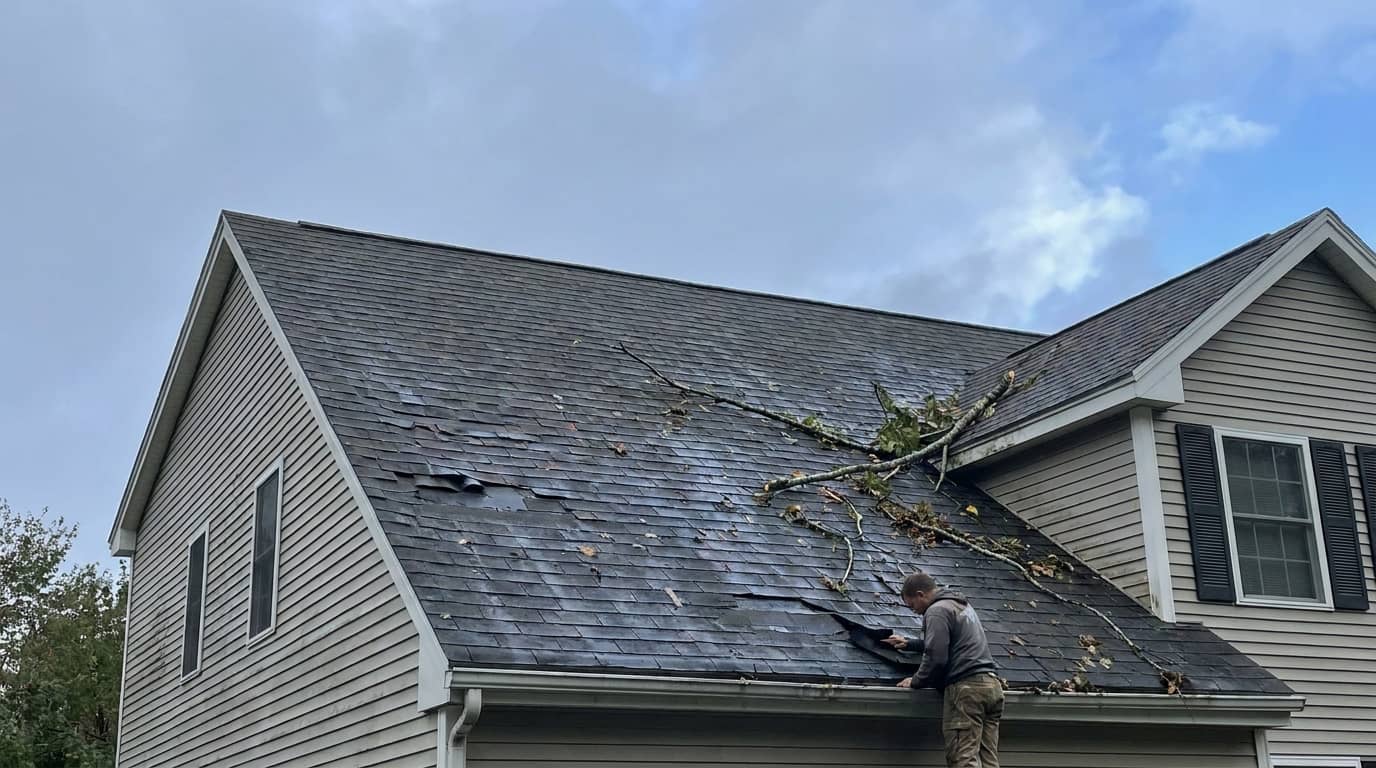
- Homeowners insurance covers sudden and accidental roof damage — storms, hail, fallen trees, fire, the weight of ice and snow. It does not cover age, wear, or deferred maintenance, no matter how badly the roof is leaking.
- The most important line on your declarations page is whether the roof is covered on a Replacement Cost Value (RCV) or Actual Cash Value (ACV) basis. On a 15-year-old roof, the difference can be $10,000 or more.
- File within 30–60 days of the storm, document everything from the ground, and have your roofing contractor on the roof with the adjuster. Those three steps decide most claims.
- Initial adjuster scopes underpay by roughly 20% on average. Supplements — additional line items submitted after the first inspection — are normal, expected, and how most claims reach their full value.
- Anyone knocking on your door days after a storm offering to “cover your deductible” is committing fraud. Stick with a local, licensed Massachusetts contractor with a real physical office.
What does homeowners insurance actually cover on a roof?
Homeowners insurance is built around a single phrase: sudden and accidental loss. If a defined event damaged your roof on a date you can point to, you’re probably covered. If the roof has been quietly failing for ten years and finally started leaking last week, you’re probably not.
That distinction sounds simple. In practice it’s where most claim disputes live, and it’s why how you describe the damage in your first call to the insurer matters more than most homeowners realize.
Typically covered
- Wind damage — lifted, creased, or missing shingles after a named storm or a documented wind event.
- Hail damage — bruised mats, fractured granules, exposed asphalt. Often invisible from the ground.
- Fallen trees and branches — including impact damage to decking and structural framing.
- Fire and lightning — including damage from firefighting efforts.
- Weight of ice and snow — when accumulation causes structural damage, sagging, or collapse. Cosmetic ice dam staining usually isn’t covered.
- Vandalism — rare on roofs, but covered.
Typically not covered
- Normal wear, age, or end-of-life shingle failure.
- Lack of maintenance — clogged gutters, missed repairs, ignored leaks.
- Cosmetic-only damage on some policies (a growing exclusion).
- Pre-existing damage the carrier can show you knew about.
- Animal and insect damage — squirrels, woodpeckers, carpenter bees.
- Flood damage — that requires a separate NFIP policy.
- Mold and rot caused by long-term leaks.
The grey area is large. A 17-year-old roof that loses 30 shingles in a nor’easter has a real claim, but the insurer will push for ACV settlement on the basis of age. A 6-year-old roof with the same damage almost always gets full RCV. The age of your roof is the single biggest variable in how an insurer handles your claim.
Two of the most-searched coverage questions get their own deeper answers: whether insurance covers a roof leak (it depends entirely on what caused it), and how carriers handle ice dam and snow-load damage — the most New England of roof claims.
ACV vs RCV vs functional replacement — what’s on your declarations page?
Pull your homeowners declarations page before you make any phone call. Find the section for Coverage A (dwelling) and look for how losses are valued. There are three settlement frameworks you’ll see in Massachusetts:
| Settlement type | What it pays | Payment structure | When carriers apply it |
|---|---|---|---|
| Replacement Cost Value (RCV) | Full cost to replace the roof with materials of like kind and quality, no depreciation taken. | Two checks: ACV up front, recoverable depreciation released after work is complete and invoice submitted (typically within 180 days). | Standard on most newer policies and most roofs under 15 years old. |
| Actual Cash Value (ACV) | Replacement cost minus age-based depreciation. On a 15-year-old roof, often 40–60% less than RCV. | One check after the adjuster sets the depreciation schedule. | Common on roofs over 15–20 years old, in coastal zones, and on FAIR Plan policies. |
| Functional Replacement | Replacement using cheaper but functionally equivalent materials (e.g., basic 3-tab in place of architectural). | One check, calculated against the lower-spec material. | Some endorsements on older homes, especially historic properties. Read the endorsement closely. |
Here’s the math that matters. On a $25,000 roof replacement with a $2,500 deductible:
- RCV outcome: $25,000 − $2,500 deductible = $22,500 to you, paid in two checks. You’re out $2,500 out-of-pocket.
- ACV outcome (15-year-old roof, 50% depreciation): $12,500 − $2,500 deductible = $10,000 to you, in one check. You’re out $15,000 to complete the same job.
That difference is why the first call you make should be to read your declarations page out loud, not to your insurer’s 1-800 number. If you’re on ACV and didn’t know, you have time to budget. If you’re on RCV, you need to plan to complete the work within the carrier’s window to recover the depreciation. Because age is what usually triggers the step-down to ACV, it’s worth understanding how insurers treat an older roof before you file.
“The homeowners who get the cleanest claim outcomes are the ones who read their policy before they call the insurer. When you know whether you’re on RCV or ACV, you stop hoping and start planning. The insurer’s adjuster doesn’t have time to walk you through your own coverage — that’s on you.”
Global Roofing field team — based on hundreds of MA storm claims
The 11-step roof insurance claim process
The steps below are the working sequence we walk Massachusetts homeowners through after a storm. Done in order, a typical claim moves from documentation to first payment in four to eight weeks.
- Document the damage immediately. Photograph from the ground — never get on a wet roof. Save weather reports and date-stamped news coverage. Note the exact date of loss; you’ll need it for the claim form. Our guide to documenting roof damage for a claim covers exactly what to capture.
- Prevent further damage. Tarp active leaks, remove fallen branches that are still loaded against the roof, board up openings. Save every receipt — insurers reimburse reasonable mitigation costs as part of the claim.
- Read your policy. Find Coverage A, the deductible, the settlement basis (ACV vs RCV), the wind/hail deductible if separate, and any roof-age endorsements. Don’t file blind.
- Get a professional roof inspection. Call a licensed local contractor for a damage assessment before the adjuster comes out. This gives you an independent inventory of damage and a baseline scope.
- File the claim. Call your insurer within 30–60 days. Provide date of loss, a brief factual description, and your photos. You don’t need to commit to a dollar figure; that’s the adjuster’s job.
- Schedule the adjuster meeting and have your contractor present. This is the single most important step. The adjuster sets the scope; your contractor identifies the damage and code-required upgrades the adjuster might miss.
- Review the adjuster’s estimate against your contractor’s scope. Line by line. If items are missing — replacement of all flashing instead of reuse, ice and water shield to current code, ridge cap, ventilation — your contractor submits a supplement.
- Receive the initial payment. On RCV, this is the ACV portion (replacement cost minus depreciation, minus deductible). On ACV, this is the entire payout.
- Complete the work. Hire your contractor and schedule the replacement. Keep the signed contract, all permits, and the certificate of completion.
- Submit the final invoice. Send the insurer a copy of the paid invoice, the certificate of completion, and photos of the finished roof. This triggers release of the recoverable depreciation.
- Receive the final payment. Recoverable depreciation typically arrives within 30 days. The full claim is then closed.
Walk your property after the next storm
Our Post-Storm Checklist gives you the exact ground-level inspection routine — what to photograph, what to note, and how to log the date of loss in a way that holds up with an insurance adjuster. Print it and keep it with your homeowners policy.
Get the Post-Storm ChecklistWhy your contractor should be at the adjuster inspection
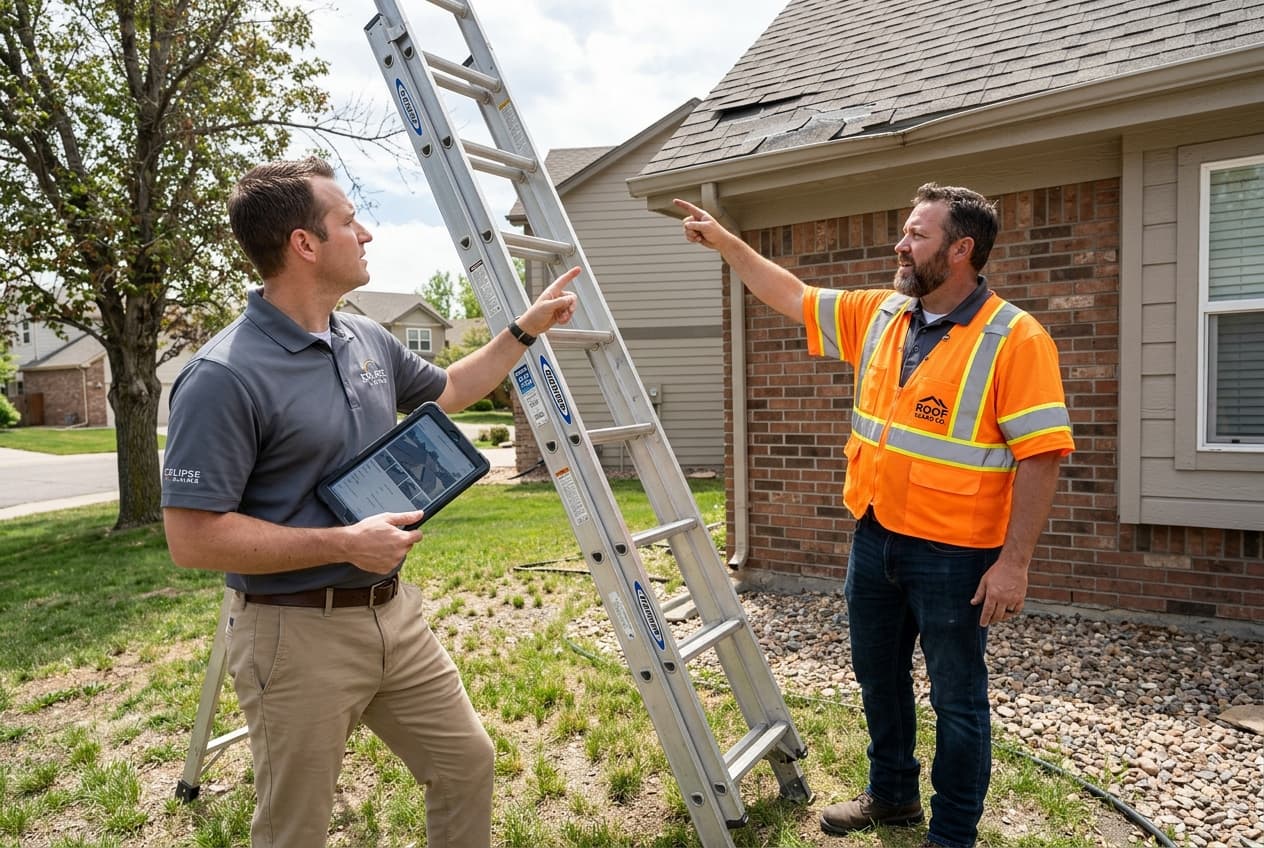
Insurance adjusters are generalists. They handle car claims, fire claims, water claims, and roof claims in the same week. Most are competent and fair. Almost none are roofers — which is why it helps to know what an adjuster actually looks for before the inspection.
That matters because hail damage on an asphalt roof looks like nothing to an untrained eye. A bruise the size of a quarter with fractured granules is a covered loss. A scuff from a tree branch or foot traffic looks similar and isn’t. A contractor who walks the roof with the adjuster can point to specific bruises, photograph them next to a coin for scale, and document the damage pattern across slopes.
What a good contractor does at the adjuster meeting:
- Walks every slope with the adjuster, on the roof.
- Identifies hail bruising, wind creasing, and impact damage.
- Flags code-required items the adjuster may not have included — ice and water shield to current 780 CMR coverage, drip edge, step flashing replacement.
- Documents test squares (typically 10 ft × 10 ft) showing impact density per slope.
- Photographs damage that supports the scope being requested.
One Massachusetts-specific note. Under M.G.L. c. 175, only a licensed public adjuster can negotiate claim terms on your behalf. Your roofing contractor cannot — and should not — get into pricing arguments with the adjuster on your behalf. They document and advocate for the scope of work; you handle the conversation about settlement. If you’re unsure who does what, our breakdown of who to talk to for a roof claim sorts out the agent, the adjuster, your contractor, and a public adjuster.
Recoverable depreciation, explained with real numbers
On an RCV policy, the insurer doesn’t cut you a check for the full replacement cost up front. They split it. The first check covers the depreciated value of the roof (the ACV portion); the second check — the recoverable depreciation — is released after the work is finished.
Worked example. Adjuster-approved replacement cost is $25,000. Roof is 15 years old; depreciation is set at $8,000. Deductible is $2,500.
- Initial check: $25,000 − $8,000 depreciation − $2,500 deductible = $14,500
- You complete the work and submit the final invoice.
- Recoverable depreciation check: $8,000
- Total received: $22,500 (replacement cost minus deductible). You’re out $2,500.
Two things sink homeowners on this. The first is the time window — most policies give you 180 days from the initial payment to complete the work and claim the depreciation. Miss the window, the depreciation goes back to the carrier. The second is the assumption that the initial check is the whole payout. It isn’t. If you take that $14,500 and pocket it instead of completing the job, you’ve permanently left $8,000 on the table and still have a damaged roof.
Seven mistakes that shrink your insurance payout
Several of these are also the reasons claims get turned down outright — if yours already has been, see why roof claims get denied and what your options are.
- Waiting weeks to document. Memory fades and so does the link between the storm date and the damage. Photograph within 48 hours.
- Filing before reading the policy. You should know whether you’re on ACV or RCV before you ever pick up the phone. The conversation is different in each case.
- Making permanent repairs before the adjuster sees the damage. Tarping is fine and expected. Replacing shingles is not — it erases the evidence the adjuster needs.
- Going to the adjuster meeting alone. Without a roofer on the roof, you’re relying on the adjuster to find damage they aren’t trained to see.
- Accepting the first scope without review. Industry data suggests initial adjuster scopes underpay by roughly 20% on average. A supplement isn’t adversarial — it’s how the process works.
- Signing an Assignment of Benefits with a storm chaser. AOB hands control of your claim — and your check — to a third party. Massachusetts has no statutory ban on AOBs (unlike Florida), so the protection has to come from you.
- Letting the recoverable depreciation window expire. Get the contract signed and the work scheduled inside 90 days, not 170.
Massachusetts-specific insurance rules
Five things that work differently here than in most of the country:
- DOI Bulletin 2025-02 limits aerial-imagery decisions. The Massachusetts Division of Insurance restricts how carriers can use drone and satellite imagery for nonrenewal, cancellation, or claims decisions. Imagery alone can’t be the sole basis, and images must be less than 12 months old. If your insurer is non-renewing based on a satellite photo, that’s appealable.
- The FAIR Plan (MPIUA) is the insurer of last resort. If you’ve been denied by two or more standard carriers — common in coastal towns and on older roofs — the Massachusetts Property Insurance Underwriting Association will write a policy. Premiums are higher, settlements are usually ACV, and roof-age limits are stricter.
- Coastal non-renewal pressure is real. Recent industry data shows non-renewal rates of roughly 11.6% in coastal Massachusetts. Roof condition is one of the top factors carriers cite at renewal.
- No statutory AOB ban. Unlike states with explicit Assignment of Benefits prohibitions, Massachusetts allows AOBs. If you sign one, you’ve handed your claim to a third party. Don’t.
- Consumer complaints go to the DOI. If your carrier is acting in bad faith, the Division of Insurance takes complaints at csscomplaints@mass.gov or 617-521-7794. They cannot force a settlement, but they can open an investigation.
“The biggest mistake we see in Massachusetts is homeowners signing whatever paperwork the first person at the door hands them. After a big storm, dozens of out-of-state operators show up with clipboards. The locally licensed, permanent-office contractor will still be here in a year. The clipboard guy won’t.”
Global Roofing field team — South Shore storm response
How to spot a storm chaser
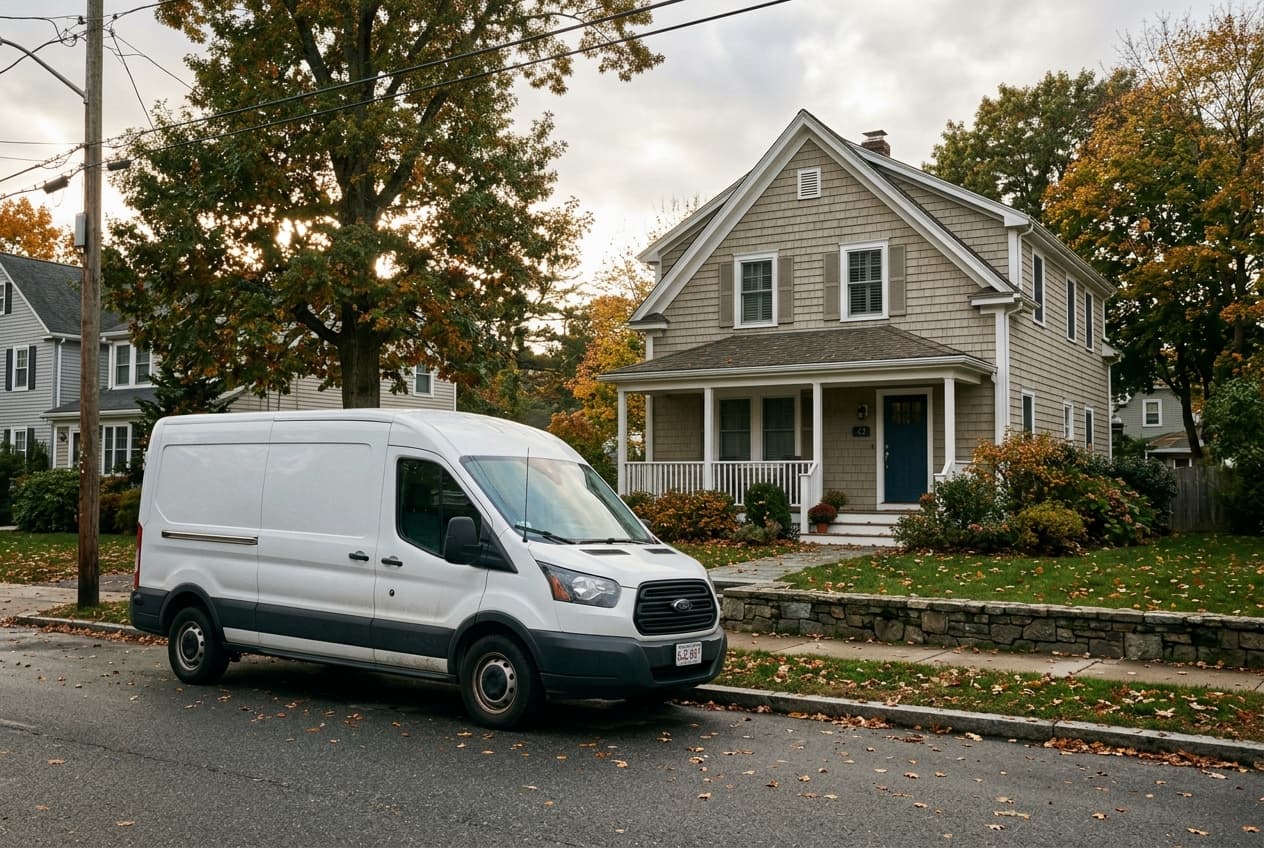
After every major Massachusetts storm, a wave of out-of-state operators arrives. They knock on doors in damaged neighborhoods, promise insurance work, collect deposits, and are gone before the project ends — or before any warranty would be honored. The patterns are easy to recognize once you know them.
- Door-to-door solicitation in the days right after a storm. Reputable local contractors are scheduling pre-booked inspections, not knocking doors.
- Out-of-state plates, unmarked vehicles, no permanent local office. A Massachusetts address that turns out to be a UPS Store mailbox is the most common version.
- Pressure to sign today. “This price is only good while we’re in the neighborhood.” Real contractors don’t price by zip-code visit.
- Offering to pay or absorb your deductible. Fraud. End of conversation.
- Asking for large upfront payment — anything over 30% before material delivery is a problem.
- Vague or verbal-only contracts. Massachusetts requires written home improvement contracts over $1,000 under M.G.L. c. 142A.
- “We’ll handle the insurance for you.” Negotiating claim terms requires a public adjuster license. A roofing contractor offering this is operating outside the law.
- No proof of workers’ comp and general liability. Both, in writing, in their company’s name.
- No verifiable local references from the past 12 months.
- Asking you to sign an Assignment of Benefits. Don’t.
Frequently asked questions
Does homeowners insurance cover a roof replacement in Massachusetts?
Most Massachusetts policies cover a full replacement when the damage is sudden and accidental — wind, hail, fallen trees, fire, lightning, the weight of ice and snow. Damage from age, wear, or deferred maintenance is not covered. The size of the payout depends on whether your policy is RCV or ACV and how old the roof is at the date of loss.
How long does a roof insurance claim take in Massachusetts?
Four to eight weeks from filing to first payment for a straightforward storm claim. Add another two to four weeks if your contractor needs to submit a supplement. Recoverable depreciation typically arrives within 30 days of submitting the final invoice, and most carriers give you 180 days from the initial payment to complete the work.
What is the difference between ACV and RCV on a roof claim?
Replacement Cost Value pays the full cost to replace the roof, minus deductible — released as two checks (ACV portion up front, recoverable depreciation after work is complete). Actual Cash Value pays only the depreciated value, in one check. On a 15-year-old roof, ACV may pay 40–60% less than RCV.
Should my roofing contractor be at the adjuster meeting?
Yes. The single biggest predictor of a fully-paid claim is having your contractor on the roof with the adjuster. They identify damage the adjuster might miss, document hail bruising and wind creasing, and flag code-required items that belong in the scope. They cannot negotiate the claim on your behalf — that’s a public adjuster role under M.G.L. c. 175 — but they can document and advocate for the scope.
Will filing a roof claim raise my home insurance premium?
Usually not for a single weather-related claim. Massachusetts insurers typically reserve premium increases and non-renewals for patterns of claims or for properties with deferred maintenance. A successful storm claim that brings your roof up to current code often improves your insurability.
Can a roofing contractor pay or waive my insurance deductible?
No. Offering to pay, absorb, or waive a homeowner’s deductible is insurance fraud — a felony in most states and a clear sign of a storm-chaser operation. A reputable contractor will help you document damage and present scope to the adjuster. The deductible is yours.
How long do I have to file a roof claim after a storm?
Most Massachusetts policies require notice within a reasonable period — typically interpreted as 30 to 60 days from the date of loss. File promptly even while you’re still gathering documentation; you can always provide more later.
How we wrote this guide
This guide was researched against the Massachusetts Division of Insurance Bulletin 2025-02, M.G.L. c. 175 (public adjusting), M.G.L. c. 142A (home improvement contracts), and published claims data from the Insurance Information Institute and the National Association of Insurance Commissioners. It was reviewed for technical accuracy by a licensed Massachusetts roofing contractor on the Global Roofing team. See our full editorial process for how we research, write, and update every guide.
Sources
- Massachusetts Division of Insurance — bulletins, consumer complaints, and FAIR Plan information. mass.gov
- Insurance Information Institute — homeowners claims data and ACV/RCV guidance. iii.org
- Massachusetts Property Insurance Underwriting Association (FAIR Plan). mpiua.com
- M.G.L. c. 142A — Massachusetts Home Improvement Contractor Law. malegislature.gov
- National Roofing Contractors Association — storm damage inspection best practices. nrca.net