


Key Takeaways
- A roof claim involves four roles: your insurance agent, the insurer’s adjuster, your roofing contractor, and sometimes a public adjuster.
- The insurer’s adjuster works for the carrier; a public adjuster is a licensed pro you can hire to work for you. They’re on opposite sides.
- Your contractor documents damage and submits a supplement when the adjuster’s scope falls short — a normal part of the process.
- In Massachusetts, only a licensed public adjuster can negotiate your claim. A roofer can document and advocate for scope — Global Roofing is a roofer, not a public adjuster.
The cast of a roof insurance claim
A roof claim can put four different people in your orbit, and they don’t do the same thing. Lean on the wrong one — ask your roofer to negotiate, or expect the insurer’s adjuster to look out for your payout — and you’ll be frustrated. Sort out who does what and the whole process gets calmer.
Here’s the cast: your insurance agent, the insurer’s adjuster, your roofing contractor, and — in some cases — a public adjuster. The pillar guide on how roof insurance claims work lays out the steps; this article is about the people who move through them.
Your insurance agent
Your agent is your point of contact for the policy. They sold it or service it, and they can explain what you carry — your deductible, whether your roof is on replacement cost or actual cash value, any wind or roof-specific terms — and how to file. When you have a question about what your coverage means, the agent is usually the right first call.
What an agent generally doesn’t do is decide your claim or set the payout — that’s the adjuster’s role. Think of the agent as your guide to the policy, not the person who adjudicates the loss.
The insurer’s adjuster
The adjuster works for the insurance company. After you file, the carrier assigns one to inspect the roof, determine the cause and date of loss, and set the scope — the list of what the company agrees to pay for. They’re the one on your roof with a camera and a chalk square.
It’s worth being clear-eyed: a fair adjuster is still representing the carrier’s interests, and most are generalists rather than roofers. That’s not a knock — it’s just why your own documentation matters. For a close-up on the inspection, see what a roof adjuster looks for.
Your roofing contractor
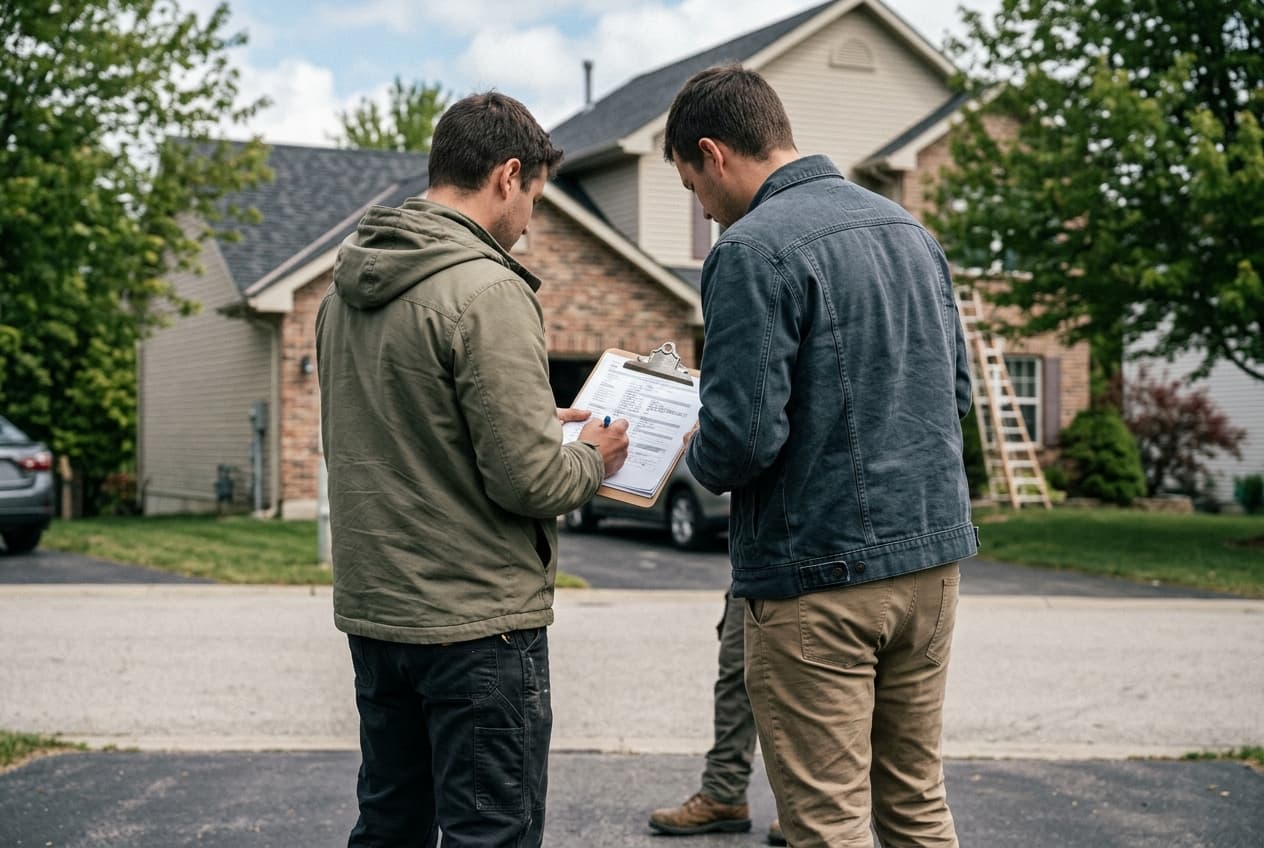
Your roofing contractor is the one who actually knows roofs. Their role in a claim is to inspect and document the damage and its cause, provide a scope of work and total price, and ideally be on the roof with the adjuster to point out damage and code-required items a generalist might miss.
This is where the term supplement comes in. Adjusters’ first estimates often leave things out — all of the flashing instead of reusing some, ice-and-water shield to current code, or damage that only shows once the old roof comes off. When that happens, the contractor submits a supplement: additional documentation asking the insurer to add those items to the scope. The adjuster reviews it and adjusts. It sounds adversarial, but it’s a routine, expected step — the scope getting corrected to match the real job.
The one thing a contractor can’t do, in Massachusetts, is negotiate your claim. They document and advocate for the scope of work; they don’t haggle the settlement on your behalf. A contractor who promises to “handle the whole insurance thing” or negotiate your payout is stepping outside their lane — and that’s one of the warning signs the pillar guide flags in its section on spotting a storm chaser.
The public adjuster
A public adjuster is the role most homeowners have never heard of. They’re a state-licensed professional you can hire to handle and negotiate your claim on your behalf — essentially your counterpart to the insurer’s adjuster. They typically charge a percentage of the settlement.
The key contrast: the insurer’s adjuster represents the carrier; the public adjuster represents you. People usually consider one for a large, complicated, or disputed claim where having a professional negotiator matters. In Massachusetts, public adjusters are licensed under M.G.L. c. 175 — and you can and should verify that license before signing anything.
Where Global Roofing fits: we’re a roofing contractor. We document damage and scope and can stand on the roof with your adjuster — we are not a public adjuster, and we don’t negotiate your claim. If your claim needs a negotiator, that’s a licensed public adjuster’s job, and it’s often where the conversation turns if a claim is denied or badly underpaid.
“We tell homeowners exactly where the line is. We’ll get on the roof, document every bit of damage, write the scope, and submit a supplement if the adjuster missed something. What we won’t do is negotiate your settlement — that’s a public adjuster’s license, not ours. Anybody in a truck telling you they’ll handle your whole claim is telling you something that isn’t theirs to handle.”
Global Roofing field team — Massachusetts in-home estimates
Start with documentation, whoever you call
Every role above works better with a well-documented claim. Our Post-Storm Checklist walks you through capturing the damage, cause, and date of loss before the calls begin.
Get the Post-Storm ChecklistWho to call, and when
- Question about your coverage or how to file? Your insurance agent.
- Need the roof damage assessed and documented? A licensed roofing contractor — ideally before or around when you file.
- The insurer’s inspection and scope? The adjuster the carrier assigns. Have your contractor there.
- Scope came back short on covered work? Your contractor submits a supplement.
- Large, complex, or disputed claim you want negotiated? A licensed public adjuster.
- Think the claim was handled improperly? Your state insurance regulator — in Massachusetts, the Division of Insurance.
Frequently asked questions
Who do I talk to first for a roof insurance claim?
Usually your insurance agent, to understand your coverage and how to file, and a licensed roofing contractor, to inspect and document the damage. The insurer then assigns an adjuster to inspect and set the scope.
What’s the difference between an insurance adjuster and a public adjuster?
The insurer’s adjuster works for the insurance company and sets what it will pay. A public adjuster is a licensed professional you can hire to negotiate the claim on your behalf, usually for a percentage. They represent opposite sides; a roofing contractor is neither.
What is a roof insurance supplement?
Additional documentation a contractor submits when the adjuster’s initial estimate leaves out needed work — extra flashing, code items, or damage found during the job. The adjuster reviews and adjusts the scope. It’s a normal, expected part of the process.
Can my roofing contractor handle my insurance claim?
A contractor can inspect, document, scope, and be on the roof with the adjuster — but in Massachusetts only a licensed public adjuster can negotiate the claim on your behalf. A contractor who offers to negotiate your settlement is operating outside their role. Global Roofing documents damage; we are not a public adjuster.
How we wrote this guide
This article explains the roles involved in a roof insurance claim; it is not legal advice about your claim. It was researched against M.G.L. c. 175 on public adjusting, Massachusetts Division of Insurance materials, and Insurance Information Institute and NAIC guidance, and reviewed for accuracy by a licensed Massachusetts roofing contractor on the Global Roofing team. See our full editorial process for how we research and update every article.